
Sue Cottrell
Interviewee: Susan Cottrell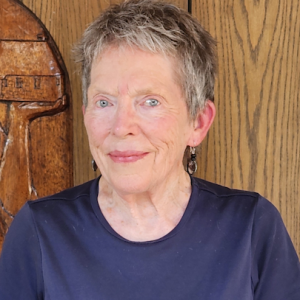
Interviewers: Gansevoort Dunnington and Frederick Cutting
May 9, 2024
Frederick Cutting: This is Frederick Cutting and Gansevoort Dunnington. I am pleased to welcome Susan Cottrell, who I am interviewing on behalf of the Saint Helena Historical Society's oral history program. We are conducting this interview at four o'clock, on May 9th, 2024 at Susan's house here in Saint Helena, California. Welcome Susan, can you begin by telling us where you were born and some of your earliest memories?
Susan Cottrell: I was born in Pittsfield Massachusetts, October 30th of 1937, I don't remember the day. My father and mother and I moved to Burlington, Vermont in 1940. My younger brother, Ray Torrence Bates, “Torrey”, was born July 21st, 1940. He's named after our grandfather on my father's side, Ray Torrence Bates. I attended Burlington grammar school and junior high and high school, graduating in 1955.
And then I left Burlington to go to college at Cornell University in 1955.
During my time in Burlington lots of fun things happened. I was very active in a junior choir in our church, Saint Paul's Episcopal Church. It was a choir of fifty kids, you can imagine. And our director was a professor of Music at the University of Vermont so we learned lots of liturgical music at a young age for which I've been very grateful [ever] since.
I was able to walk to school and walk home from school
Nobody had cars, as far as even in high school it was a big deal to get your license in high school and I don't know anybody that owned a car in high school. It was a really, really big deal If you could borrow your dad's car to go to the prom.
FC: Yeah?
I had a dog named Brownie, had a rabbit named George
SC: So I had a chance to do that once. It felt pretty darn special. We had ducks periodically. My grandparents had a camp–in Vermont you’d call it a camp, here you'd call it a cottage–on Lake Champlain, which Burlington is located on Lake Champlain. Twelve miles across the lake is Port Kent, New York, and so there were lots of lake activities and I always would go, you'd say “out to camp” on a hot summer day and it was just about a 15-minute drive, which is a treat.
FC: I'm sorry, did you say your parents' names?
SC: My mom's name is Lucene Little Bates.
FC: Okay.
SC: My father's name is Harold Sydney Fassett Bates. [whispers] I can check the spelling.
FC: All right, and what did they do for work?
SC: My mom was a dietitian at the Mary Fletcher Hospital in Burlington. But, before I was born she was a teacher–I think biology teacher–in Pittsfield, or Lee, Massachusetts, where I lived, then she became a dietitian. Actually, at the same time I was going to college, and she worked atMary Fletcher Hospital in Burlington Vermont.
Her job is interesting because many people would be diagnosed as diabetics as adults
She would have to talk to them about a good diet for them. It was hard for most people to figure out what a good diet was, and she always used the analogy of “what would you feed your cow?” Or “what would you feed your horse?” If you fed your horse chocolate or something like that, how would the horse or cow react? And they'd say, “well, it would get sick”, and she said, “well, that same thing could happen to you” and I just thought she had a lot of success using those examples. I was very active in school government, I was a delegate to girls state. I don't know if they have that at St. Helena High School.
GD: Oh no, we have… Yeah, actually we do, we have state. Yeah.
I was also a cheerleader in Burlington
SC: So I went to our state capital of Vermont which is Montpelier Vermont. Then everybody has a job when you're at Girls State. I think I was maybe the Town Sheriff. I Don't remember [chuckles]. It was a great experience to be with kids from all over the state. I was also a cheerleader in Burlington and the year 1955, our team, the Burlington Seahorses, won the state championship and we went to Boston for the New England playoffs in Boston Garden.
As a cheerleader, we were down on the floor, but the few people that had come to support us on a bus were like the fifth level up. So, it never felt like anybody could hear us going [imitates a cheerleading act], but it was exciting just to be in a big city like that.
GD: You said you moved from where to Vermont?
SC: Pittsfield, or it's actually Lee Massachusetts to Vermont.
GD: Mhm. How was that moving around? And, you know?
SC: I was just a baby so I don't remember that.
GD: Okay.
SC: Then, when I got to Burlington, we lived in a house on a street called Isham Street, where my brother was born. After that we moved to 93 Robinson Parkway, where I lived until I went to Cornell.
FC: And you said your grandparents lived out there as well?
SC: My grandmother and my grandfather, yes.
FC: Did you have other family members that were also living in Burlington?
SC: My aunt and uncle also lived in Burlington, and it was during the war when I was there and my uncle went off to war. He got married. They shortened his time at University of Vermont so he graduated maybe in January and normally he would have graduated in June. And he was married right away and then went off to the Army and I was flower girl in their wedding. He was in the Philippines most of the time. My memory about the war, two things, because Burlington is only about 90 miles from Montreal, and there was some concern that maybe planes might come over our area and so we had kind of a cream-colored shade that we pulled down over the windows at night and then a very dark green shade that was a supposed to be a darkening shade so you couldn't see any light from outside. Which has affected the way I sleep now because I like it really dark [laughs] when I sleep.
GD: So growing up people in your community and just people around were worried about, you know, like nuclear warfare?
SC: Not nuclear, just war. There was a board in our church that kept filling up with names of people who had been killed in the war, and as a little girl, that was frightening to see. We had–because things were very difficult to get–you didn't ever go anywhere in a car because gasoline was so expensive; just regular staples like sugar and butter were virtually impossible to get, because Vermont is the dairy state, milk was easy to come by.
But we had margarine, you know, fake butter, and it came in a bag. It looked like Crisco. But they had a red button in the middle of the bag that you punched the button [imitates punching a hole] and would supposedly color it so it would look yellow. But invariably the bag was really thin material and it always broke.
Everybody seemed to have a victory garden . . .
So it was my brothers and my job to punch it and that was a [imitates flatulence noise] all over the place [laughing]. But we didn't know any better that we were in a tough time. Everybody seemed to have a victory garden, and so there was a place near the University of Vermont–I lived between the boys dorms and the girls dorms–and there was a big area, not too far away, that was designated for victory gardens. So different families had rows that they planted of vegetables. So that's how we got fresh vegetables, because everything else was canned.
GD: Growing up, what was your, I guess, community and support system like?
And who were your closest friends? And how did you meet them? And, you know, what type of things did you guys do?
SC: My closest friend is my friend Pam Palmer, for whom this girl is named, [gestures towards her daughter Maxine, previously Pamela, Cottrell, who is at the other end of the room] and her father was a funeral director and it's given me–which I didn't realize at the time–a really wonderful way to think about when people die. Because, it was just so matter-of-fact.
Just the way you talk about if your dad was a butcher, well he went to work and this is what he did; or your dad was a mailman. It never seemed odd to me, and when different relatives of mine would die, Pam would often call and say, “well, we've got Bertha all fixed up, she looks great, come on down, we have visiting hours now” and it never seemed scary, and so I remember going to funerals, of family members when I was a little girl and it wasn't frightening, and we would go out to the cemetery and bring flowers and oftentimes, you know, after the funeral and then sometimes on the anniversary of that person's death or their birth, we would go out to the cemetery.
GD: Also growing up, how was, I guess, health and you know, the hospital system and things like that?
What were like… were there home remedies or?
SC: There probably were home remedies, I am sure there were.
GD: Did your family have any?
I was having convulsions because my fever had gone really high and I developed encephalitis from measles
SC: I gotta think about that. Well, I do know one thing: when I was, I think it was five years old, I had measles and it's before they had a vaccine for measles. My parents said that I was getting better and then suddenly one day my mother went into my room and I was having convulsions because my fever had gone really high and I developed encephalitis–which is a inflammation of the brain–and there was no known treatment for it, so I was taken to the hospital.
There they didn't know if I would live, evidently, and if you do survive it, oftentimes people have long-term disabilities; either blindness or some sort of a major disability. I'm really grateful. I think when I die I would like to have my brain checked because who knows, maybe it did impact my brain in some way. But it was before penicillin so the drug of choice was Sulfa, and my second teeth were just coming in and Sulfa was, you know, wreaked havoc with those teeth so, I've spent a lot of my time in a dentist chair, ever since.
GD: And, so you went to Cornell, and so tell me about your college years and what was your major and what did you study? And, you know, life on campus, I guess.
SC: Life on campus was great. I really wanted to meet new people, it was scary to go. I had never taken the college tour, I don't think people did that then. So the first time I showed up was when my father brought me, day one. I was so used to the University of Vermont campus, which, you know, I could walk from one side to the other and it took me six weeks–no kidding–to find my way to some of my classes.
I was in the school of human ecology and it was quite a ways from my dormitory [exhales humorously]. I lived on the third floor and there was no elevator, we walked up–fourth floor [corrects herself]–we walked up. That was my freshman year. My sophomore year, I lived across the street and I joined a sorority, Pi Beta Phi sorority, which was fun because it was a smaller group of people with whom I could get to know and to do things with and that year I lived in the sorority house; and to help defray some of my expenses, I waited table. [exhales humorously]
I'm gonna tell the story: at one point, my parents were divorced–I forgot to mention that–when I was in high school and my father [had] moved to Maine. He worked for a lobster company and one time he sent a whole bucket of lobsters in a big can of salt water and the only thing we had to do was punch holes in the top of the can and put it on the stove… and steam them. I think we had one lobster cracker in the house–like a nutcracker–so to see these girls from the Midwest, trying to wrestle with a lobster, we wasted so much. My heart breaks today but it was quite a treat, it was quite a treat. In my sophomore year, no, in my junior year, I was back in a dorm and I was a dorm counselor. So I had, you know, a quarter to be responsible for.
This is interesting, because at Cornell at that time, they had two student governments; they had a men's student government and a women's student government.
I know that sounds crazy to you, but that's the way it was. So, I remember running for–a good friend of mine was going to run for president–so I said, “okay, I'll run for vice president” and there are quite a few folks running, and so I remember going to a movie that night, when I came home they called and said “you just won to be vice president”. So that was a treat and my job was to be in charge of–or responsible for–all the dorm counselors and all the dorms, so we would have periodic meetings. It was kind of, it sounds exciting, but it's hard when you're trying to do your whole school, that's why you're there, to try to fit everything in.
I remember that was a big challenge. Then I had a big honor… Going into my senior year, I was chosen to be a delegate for my sorority to go to the National Convention. Occasionally that convention had been held in California, which I'd never been to or Seattle, or the Midwest, or Texas. The particular year I went, it was held at the New Ocean House in Swampscott, Massachusetts where curiously enough I had worked the summer before.
When I arrived with the other Pi Phi delegates, the normal people that work there most of the summer–not just college kids–said to me–two or three of them–“how did you come into money so you could come in the front door?” and so I had to explain what happened, I thought: “I could have gone anywhere but at yours”, anyway… [Shrugs and smiles]
FC: So you met Tom Cottrell at Cornell?
SC: At Cornell. He was president of his fraternity Beta Theta Pi and I was just a member of my sorority and we were brother and sister fraternity-sororities, I guess.
So, periodically, we'd have events together and there was a potluck one night, and he was late and I was late, so we were both last in line. So that's how we got to meet and got to talking and it was fun. He had just come home from two years in the Army. He had started Cornell earlier and then I think, for whatever reason, he decided to join the Army. Then [he] came back, and when he came back he brought with him a bright blue Volkswagen that looks like Max's car now [gestures to her daughter in the room and her daughter’s car outside], it's about that same color, bright blue. So there were very few cars on campus, but we could always find Tom's because it was bright blue.
And his major was engineering physics. There were several engineering schools at Cornell: chemical engineering, civil engineering, mechanical engineering, but engineering physics was the smallest of the colleges, I think there were only twenty five in his graduating class. His father, Casper, was a professor of electrical engineering and his mom, Ernest, had received her degree in physics from Vassar, so it was a very well-learned family. Tom has two older sisters: Anne and Pat. Anne went to Cornell, I don't know that Pat went to Cornell.
GD: After you graduated, did you stay near Cornell or…?
SC: I did, because a month after I graduated I was married and Tom
I still had another year cause his engineering program was five years and I was also just pregnant, so I had my first baby in Ithaca, April, 1960… James [name of her first child].
GD: And after he finished his last year, did you guys move West?
SC: No, we moved to Wilmington, Delaware, because he worked for DuPont
That's where Maxine was born, in Wilmington Delaware. So, we were there for maybe a couple of years and then he decided that he wanted to go to school some more to get advanced degrees. So we moved to the next town, which is called Newark–not New York, Newark, Delaware–where the University of Delaware is located and he did his Masters at the University of Delaware. After that, we moved–and that's where Maxine was born [Newark], as I said.
We moved to Rochester, New York so he could do his Doctorate at the University of Rochester, in Laser Optics and that's where he graduated from.
FC: So you moved from…?
SC: From Newark, Delaware, to Rochester.
FC: Okay, after college?
SC: Yeah.
FC: And so, Tom got his second degree up…?
SC: Second degree at University of Delaware.
FC: Okay.
SC: Masters. Doctorate at University of Rochester.
GD: And, after he got his Doctorate, what happened then? Is that when you guys decided to move?
SC: Mhm. The person for whom he was working–doing his doctoral dissertation–was a man named Ken Sinclair. He had accepted a job at Spectrophysics in Mountain View and the company builds lasers, and that was what Tom's doctorate was all about, lasers.
So he said “well, why don't you apply for a job too?”
So we did, and that's how we came to California. But I've got a story prior to that. One day Tom was working in the lab and suddenly the power went out and he thought “what did I do?” he thought maybe doing an experiment that he must have caused the power to go out. So he went out in the hall and he said “oh my God, all the lights are out in the hall” and then it was time for him to go home, so he went down the stairs and realized the whole building was out he thought, “what did I do? [raises voice] I've really done something big” and then he got to the parking lot and no lights on anywhere, and gradually the awareness came. I think he turned on his car radio, that was a big blackout in the East. I mean, almost the whole East Coast, and initially he thought “I caused it.'' I'm not sure what happened, there was a whole series of outages at that time, but [sigh of relief] at least he didn't cause it.
GD: What were your, I guess, first impressions of California? You know, because you grew up on the East and it's very different.
SC: Oh my gosh. Fences everywhere; fences between houses. I'd never seen anything except a picket fence and maybe not as a divider, as more something lovely that you have roses growing over, but I'm so used to one lawn going into the next lawn, into the next lawn and I thought, [gasps] I'm gonna feel claustrophobic here! I'm going to feel claustrophobic. It took a while to get used to that and, you know, these board fences that divide people… It's still a little bit of a strangeness to me, but that was the biggest thing I think.
FC: Were you a little nervous making that change when you were on the East coast?
SC: [Overlapping] I was yeah, I was. Because I had never been further west than Ithaca, as I said. Then both Maxine and James were in school and they went to St Helena Elementary School.
SC: [Gansevoort begins to ask a question and is cut off] Just a second, and in Cupertino, James was in public school, and then so was Maxine, but she was taken out of–I think it was second grade–[looks over at Maxine] Was that second grade when you had Mrs. …? Yeah. In a special class, and they did all kinds of interesting and fascinating things and very, very stimulating.
When we moved to Saint Helena she had a very traditional teacher–that we all turned the page at the same time kind-of-thing–crazy making. Crazy making for Maxine and it was really hard for me to see that. Yet, I was supporting Tom trying to… Anyway…
FC: So you were in Cupertino, was it two years?
SC: Excuse me…Excuse me, I'm mixing the timing up. We were in Cupertino about [looks over at Maxine] How long was it Max? Three, three years, yeah.
FC: Okay, and then…?
SC: Then here [referring to St. Helena]. So that story I just told you about the school was in St. Helena.
FC: Okay.
GD: And why did you guys decide to move here?
SC: Well, that's the big story. Because Tom Cottrell and a good friend of his, Tom Parkhill–who worked at Spectrophysics–had a conversation. I don't know what the genesis of it was, but I think they both enjoyed wine, and Tom Parkhill and Tom Cottrell said,
“You know what we should do? We should move to Napa Valley and start a winery.”
Like, isn't that the kind of conversation you just have every day? [says humorously]
GD: As a man that studied optic laser, laser optics? [chuckles]
SC: Yes. Yeah..
GD: And you agreed?
SC: No, I was really upset because of this wonderful schooling that particularly Maxine was having, and I just thought there were so many more opportunities there and Tom really knew what he was doing building lasers and not about anything to do with wine. But we came.
FC: Did he not find that job as interesting as he had maybe thought it would be?
SC: I think it was a lot of physical work because of a big fire had gone through Calistoga–where the property was that we had purchased–and there were a lot of dead trees, and if you can imagine, [scoffs] with your little hatchet, you feel like George Washington, chop, chop, chop and then run like hell to be sure the tree didn't fall on you. Interestingly enough, the Tubbs fire in 2017 I think, had that same path down through Calistoga.
GD: Yeah. So you know people are worried about fires here all the time right now, and that was the same when you first moved here?
SC: No, it wasn't. We weren't worried about fires but we had to cut those dead trees. But that was caused by a fire.
GD: Yeah. So Tom did, you know, start this Winery? It was Cuvaison?
SC: We had four of us sat around the table when we were in Wilmington, trying to come up with a name, “Would we be Parkhill?” [Pauses to thank God]
SC: Excuse me, in Cupertino. Trying to decide what this name should be, “should it be a combination of our names?” and then, because this would be only the second winery built after Prohibition–I think Mondavi was built in 1967, and this was 1970–so we said, “we should probably have something with a French name to it” because people were drinking French wine.
So the term Cuvaison means the process of making red wine in a cuvée or a vat.
There's some debate now, well between, maybe, the founders and the current people about the date the winery started. On the plaques it now says 1970, No, ‘69, and I know we didn't move here till 1970, but I think, perhaps there might have been some legal thing done in ‘69. Anyway, Cuvaison has celebrated–is still in existence, different owners of course– it just celebrated its 50th anniversary a couple years ago and Maxine and Anne, your mom [addressing Fred], and I were invited. Prior to that event the CEO, who was an old friend, came over to the house, went through all the pictures I had and framed–a lot of them for the event–and it was just a great experience.
GD: And for Cuvaison did you do any jobs or work for the winery or you did your own thing?
SC: Well, Chris, I mean Maxine and James helped bottle, [addressing Maxine] was that the first and the second year Max? Yeah; everybody was. But by then your mom [addressing Fred] was born and then Chris was born. So I wasn't too much hands-on and we didn't have that. We'd already sold the winery by the time Chris was born.
GD: How do you remember Saint Helena was different from when you first moved here to how it is now?
SC: Well, the big thing, the traffic light on Maine and Madrona. There was no traffic light, no traffic lights in St Helena at all. And I remember thinking, “I can't go to Safeway on a Saturday because there's going to be too much traffic going up and down Main Street.” So, that was the first traffic light. I think…[addressing Maxine] was the second one Pope Street Max? I think the second was Pope Street, and then, just a few years ago, the one at the high school.
GD: And how did people get around in St Helena? Were people driving more than they were when you grew up on the East?
SC: Oh yes, I think we still walked a lot, and you biked [gesturing towards Maxine], they biked to school.
FC: So, for the kids how was that transition to the new schools? You talked about that a little earlier, but…
SC: I think it was really hard for Max. I think it was great for James, he was in fifth grade and he had one of these… rousing teachers, her name is Mrs. Meldrum and she played the piano. Of course, Uncle James loved just dancing around and that was a good experience for him, but it wasn't so good for Maxine. I felt really badly about that.
FC: But you found the Grace Church, which you said you went there your first Sunday you came to St Helena?
SC: [Overlapping] First Sunday we were here, and Grandpa Tom [Tom Cottrell] was the treasurer at one time of the church and so that was a big place for me. I like to be involved in all the different activities. I was a Sunday school teacher, I was the governing body of the Episcopal Church, it’s called a Vestry. I was on the Vestry and yeah, I really enjoyed that experience.
GD: So when you moved here, since you're in all these activities, you didn't really have much troubles finding friends, did you?
SC: No, I feel very grateful, I feel very grateful. The neighbor across the street is still a good friend, on the corner of Vineyard and Hillview: Helen Christensen. She was Anne's first grade teacher. Did you know that? Yeah.
GD: [Overlapping] Oh, I was gonna ask another question.
SC: Go Ahead.
GD: So, I was reading the St. Helena Star and from you know, newspapers from when you first moved here, and it was interesting reading about, you know, a lot of stores that, you know, don't exist, but also stores like Sunshine that are still here and they had advertisements in the paper for different things and also there's advertisements like sporting events. For baseball games here in St. Helena. Did you, you know, was that part of something you did to entertain yourself, go to those games?
SC: I've always been a big baseball fan and so yes. I would go to everything that was at that school and then I didn't get to be a Giants fan [San Francisco Giants] until I moved here. But before that I had gone to the A's games when we lived in Cupertino. But I love the Giants here and started a group when the Giants were still at Candlestick, and the group still exists today, and we have season tickets, and we meet once a year to draw our tickets in March.
Then if they're in the postseason, we meet again in the fall. We have never been to a game together, so after 25 years, I said, “don't you think we should spring to rent a box sometime and a bus and all go down and sit together for a game?” Because we each get two two seats per season.
FC: Have you guys done that yet?
SC: Not yet! [smiles] I just proposed it last week again. [laughs]
GD: And what was the name of that group? Was there a name or was it just a group of people that all pitched in?
SC: All pitched in, we just call it our San Francisco Giants Group.
The second winery opening after prohibition
GD: I know that there's a lot of people here in Santa Helena that are a little bit lenient–you know, the stigma around alcohol is different because we produce it, it's a big part of our community– so when you moved here, was there a big difference between, you know, I guess severity, you know, having been the second winery opening after prohibition? Was the stigma dramatically different from on the East?
SC: That's a good question. I'm not sure quite how to answer that and I want to be sure that when we say the second winery, I don't know that that's historically correct, we'll just double check that, but it's certainly an early one.
FC: After Robert Mondavi?
SC: Mhm. Neither Tom nor I had drunk a lot, and so I wasn't even really familiar with wine at all, and so, it was a new thing. I can remember my parents having bridge parties and they would all have high balls–I guess it was some sort of liquor and maybe ginger ale or water–but that wasn't, wasn't my experience. A lot of beer drinking in college, not me, but when I would go to parties it sure seemed like that was a big deal.
GD: Going back to like, you know, all the activities you did. When you moved here, I read a couple things about you presenting book awards, in the library or something? Is that…?
SC: I don't… Really?
GD: Oh, maybe I did some wrong research then, we'll continue then.
SC: Yeah, I had a book group, I still have a book group. We meet once a month, and we read a book and we all discuss it together, but…
GD: And Fred told me you do a Bible study every week?
SC: And that's been… Let's see… We started that when Father Mac was here in 1993 so they're
here every Tuesday night, how many years is that? [addressing Fred]
FC:I guess… 30. Yeah, 30 years about, yeah. So is that, is there still a lot of the same members in that group today?
SC: Some of the same members, but the whole idea–I think this is a secret, any group that can become so insulated and not welcoming–is that Mac always said “there's an open chair.” So the door's always open, anybody can come in. So people come and go but we've got a core. It's supposed to be a small group but if I looked at all the people that have signed up for it is probably a large group. But we get about, I would say nine to twelve each Tuesday night.
FC: And how do you, who decides what…?
SC: Jan Bradley is our leader and so she comes up with–we usually read a lesson that's going to be read the coming Sunday and then we discuss it. We start out with a tray of candles and everybody has a candle and they light it, for somebody or for a cause, maybe somebody's ill.
“I'd like to light this candle for Fred because he's sick.” Or “I'd like to light it for my mom, who's having a birthday.” And then, we have two people who play the guitar, Kathleen Keeling and Shanti Garlock, so we sing three or four songs, and then we do a particular Bible study and then at the end we go around and each offer a couple of prayers and then we have snacks. So that's a big deal, because then there's conversation.
GD: Yeah, so, after, I guess, helping out at Cuvaison, were you busy with, you know, raising your children, or did you have any, did you get another job at one point or…?
SC: Well, in 1980, which was four years after Chris was born, Tom decided that he didn't want to be married anymore.
So we were divorced, and so then I did have to go to work, and I started working at Freemark Abbey Winery in 1983, I think, it was [refering to the date] and, so I worked there for 31 years. When I retired they gave me a giant shirt that said “Cottrell 31” on the back.
I also worked for Silverado Country Club and I’d do wine tours.
So I got my class two license so I could drive a van. I would go on big buses, sometimes, that would come up from San Francisco, and it was such an amazing experience. I met so many people from so many different places. Why, can I give you one example?
FC: Yeah.
“This is heaven. I never thought in all my life that I'd ever seen anything like this.”
SC: Okay. One example was we had a group of Russian Engineers who had been in Texas studying oil wells and they had a little time before they had to go back to Siberia, which most of them were from. So they were brought to Napa Valley, and I can remember the bus was kind of ripe inside, you know, they may not have bathed. Anyway… I would say just a few words about what we were passing like, “this is a vineyard”, “this is a winery” because the translator was not translating everything I was saying, I could tell that. So, when we got to–may have been Martini Winery–we're having lunch and even walking in, everybody was stone-faced, and I felt like I just wasn't connecting with them at all.
Then we had this first course and then there was a little bit of wine poured, and then there was an entree, and then a little bit more wine poured, and then they began to open up and each person stood up and said something about this experience, and I can remember one man, tears are streaming down his face saying, “This is heaven. I never thought in all my life that I'd ever seen anything like this. I had read that this kind of thing existed, but in Siberia, when would I get to see it? So I'm really grateful” he said… That was moving.
GD: So growing up, you have gone through a lot of, you know, big historical events.
SC: Well, the war: World War II. That was huge, and really impacted all my younger years.
GD: And, like the Cold War and you just mentioned Russians, and reminded me, were people here in St. Helena, like, worried about communists or any of that?
SC: I think Joseph McCarthy was, you know, a key person that we were more worried about than the people that he was investigating because it seemed like it was indiscriminate. As far as who he would say “you're a communist so you're going to be fired” and I just remember thinking that wasn't a good way to be. I mean, you just can't accuse everybody of being communist. But there's something about the word that seemed to be frightening and I don't pretend to understand even then.
GD: And, like, what about, you know, the moon landing, did you watch that or listen to that on the radio?
SC: No. [Maxine reminding Sue that they watched it on black and white TV and stayed up all night for it] Oh yes, excuse me, excuse me. Yeah, sorry, sorry. Yes.
FC: You did watch the moon landing?
SC: Yeah.
GD: Was that something big?
SC: It was huge! I mean, we didn't get TV ‘till the Kennedy-Nixon election and then we had a little black and white with the rabbit ears [makes shape of antennae with hands]. Yeah.
FC: So later on, I guess in the Cold War were people worried at all about nuclear warfare here?
SC: I think as a possibility but not as a reality. Maybe that's too much of a generalization but it just seemed like “Oh my gosh, it is feasible” and yet, it just seemed like it might not happen–although it depended on who you read. I mean, if you read some of the writers that would be so “It's going to be Armageddon tomorrow” kind-of-thing.
GD: Yeah, places around the country in school would tell students, you know, “Duck and Cover.” Was that a thing that your daughter or your children would come home and…?
FC: [Maxine having a quiet dialog with Sue] You were raised with that... “Duck and Cover”?
GD: [Overlapping] Well you raised your children, you know, telling them…?
SC: To “Duck and Cover”. [Maxine reminding Sue of bomb shelters in the background] Oh that's true.
GD: And then I guess more modern, like, what about covid, you know?
SC: Oh my goodness. Yeah I got covid. And I wasn't really–I felt so grateful–I wasn't really that sick with it. Though I'd had it a second time and I started taking the Paxlovid and I thought “gosh I'm just remarkable, I don't have any symptoms.” Then it turned out–I'm embarrassed to say–that it was a new test, and I had read the test wrong, and I really didn't have it. So I didn't have to go through that regimen but I did anyway.
GD: Over time, how did you, I guess, perceive and absorb technology advancing, as you grew up?
We had radio, where everybody would sit around and listen to the radio
SC: We used to listen to programs we had–I can remember the first radio we had was a table model that was kind of oval like this [making an oval with her hands] and it looked like it had a cloth cover and three buttons at the bottom–If you’d look at a an old radio, you can see the kind, and that's the only method of communication we had. We did have a telephone. It was a private line which is a big deal. At our camp–my grandparents' camp–It was a party line, and as kids, of course, when you weren't supposed to, you'd be listening on.
GD: And so it went from, you know, radio and then to TV and so on, and, you know, were you able to, I guess, acclimate to the world changing?
SC: Probably too slowly, probably too slowly, I would say. Yeah.
FC: If we could talk a little bit more about Cuvaison, just how was it, like, starting the winery
What was it like, you know, growing it and then eventually you know, selling it off, how did that process kind of go?
SC: Just everything was so new, you know, it was, we had to find people who would sell us grapes for the first time.
We started out buying a vineyard from a couple in Calistoga, who were retiring, and it was 1970–it was a year of a huge frost. There are no wind machines there, there were only smudge pots and I can remember driving up, above Calistoga–I don't think we were all the way up to Mount St. Helena–but looking down in Calistoga it was just a virtual pall of black from the smudge pots, and two or three people around the vineyard that we had bought died just because of having to get up night after night to light these smudge pots, and we hadn't moved here yet and Tom was still working in Spectrophysics. So he would drive up from Mountain View, here [St Helena], to light the smudge pots and then go back down to Mountain View to work at…Spectrophysics. Yeah.
GD: He did that every night, he drove up…?
SC: Well, maybe every third night, something like that. He would have the person from whom we were buying the property do it in between nights but that's why they were selling the property, because they were getting old and it was just too much.
FC: And so there was a little bit of time when you'd purchase that vineyard up–you'd started Cuvaison but we're still living in… Cupertino?
I know we moved up here the summer of 1970
SC: Well that's a debatable thing. I think it says ‘69 [for Cuvaison’s founding date], I don't know. So when we–as soon as we moved up here, I mean, I said Tom had woken up the spring before to check the smudge pots and all.
FC: And did you move straight to Scott Street? No, we moved to…Hillview and Vineyard.
FC: Okay.
SC: The guy that owns the… Ah, what's his name [pauses for a moment and shrugs]?
FC: Okay, it's okay.
GD: What about I guess, your children… like I guess a little bit more on sending them to school here, they went through the high school and everything, was that different, or was it weird?
SC: I think it was a, I felt from my point of view, it was a better experience, especially after Max got out of that initial class. I would love to have you ask her that question, but I was involved with the different activities at the school, helping out, volunteering and one of the things I remember doing–because math was not easy for me– I remember having to repeat 8th grade math in summer school, and so I thought,
“Okay, when I’m older, I'm gonna volunteer.”
So I volunteered with a math teacher in the junior high school and it was such an incredible experience. Because the way he explained what would be basic math to you, I'm sure, was suddenly a revelation to me. [Whispering quietly] “Oh so that's the way you do it” because my dad was big in math it was easy for him, he would sit, we would look at a problem and he would tell me the answer rather than the steps to get to the answer. I never really learned how to solve a problem mathematically and so just volunteering in this 8th grade math class was the biggest experience for me and in the end it was nice.
GD: Okay. I think we have one–I'll ask one more question.
SC: Okay
GD: You know it's broad, but what is your, I guess, most important memory living here in St. Helena?
A wonderful sense of community here
SC: Seeing each of my children grow and blossom and do well, and seeing my grandchildren born. Having the privilege to be here, and to participate in activities with them and activities in the town and the church. I feel that very much. I'm very grateful for it.
GD: All right. Well, thank you very much for…
FC: [Overlapping] Yeah, thanks for letting us interview you today. Is there anything else you'd like to share?
SC: This is a great experience, I know I've left out a whole bunch of stuff but thank you for the privilege of being able to do this with you, I really appreciate it, and I have to compliment you guys, you're good interviewers, you are. It's that easy. Especially when we know each other, yeah.
GD: Alright.
[Recording ends]