
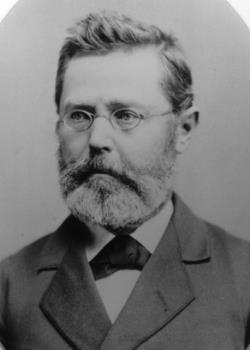
St. Helena Star, November 4, 1892. Transcribed by Mariam Hansen, 2023. The pioneer winemaker passes away after a lingering illness; his long life of usefulness described, impressive funeral services Wednesday.
Charles Krug, the pioneer wine-maker of Napa County, and one of our most highly esteemed citizens, died at his home in St. Helena Monday morning at 5:30 o’clock, after a long and painful illness with throat trouble.
Karl (Charles) Krug was born in Trendelburg, near Cassel (Kassel), Prussia, Germany on March 1, 1825. He resided at his birthplace until he was 14 years of age, when he went to a Latin school at (Bad) Hersfeld, remaining there for a term of six years and completing the full course of the school. He then went to the University of Marburg, which he attended two years.
In the summer of 1847 he came to America and located in Philadelphia. He was engaged as a teacher in the Free Thinker’s School of August Glaser until May 1848. At this time he was called by the French Revolution (to be rid of the king and form a republic) and afterwards over all continental Europe to return to Germany.
Charles wrote revolutionary articles for the press and agitated for republicanizing Germany
He worked from his home in Frankfurt, seat of the German Parliament. On September 18, 1848 he engaged in a revolutionary attempt to overthrow the parliament and create a central revolutionary government for all of Germany. The attempt failed and he was imprisoned for nine months. A new attempt to overthrow the government in Baden and Rheinpfalz in 1849 opened the prison doors for him and 100 fellow activists. In 1851 Charles returned to Philadelphia.
A year later Jacob Halmlein hired him to edit the Staats Zeitung
This was the first German language newspaper on the Pacific Coast, where he worked until 1854. Next he moved to Crystal Springs (San Mateo County) where he obtained a land grant. His first task was to build a road to his place, the first manual labor performed in his life. Then he built a log house and engaged in farming— but quit after eight months.
Charles went to San Francisco to work at a private gold refining business
In 1856 he was appointed clerk of the refining department of the United States Mint. Colonel Haraszthy, Count Wass and W. Molitor opened a gold and silver refinery, where Charles worked. In 1858 he went to Sonoma, purchased land and planted 20 acres of grapevines over three years. John Patchett (who lived near Napa) visited Sonoma and told Charles he had a fine crop of grapes and wanted them made into wine. Krug accepted the job and brought a small cider press to make the wine. The 1200 gallons was the first ever made in Napa County, other than by the old Spanish process. In 1859 Charles made wine for Louis Bruck (married to Lolita Bale) at the Bale Mill, where W.W. Lyman now resides. [This was probably when he met Carolina Bale.]
In the fall of 1860 Krug sold his Sonoma property
He also made 5,000 gallons of wine on shares at George Yount’s farm. At the end of 1860 Charles married Carolina Bale (daughter of Maria Soberanes and Edward T. Bale, deceased) in Monterey. He was 35 and she was 18. For a dowry, the couple received 540 acres of land.
In the spring of 1861 he planted about twenty acres of Mission vines
This was the second vineyard planted in St. Helena (Dr George Crane was first in 1859). The crush of 1861 was the first at the Krug vineyards. The grapes came from Knight’s Valley and about 100 gallons was produced. In the following years he bought grapes from the principal growers, but he kept adding to his own vineyard until he had 150 acres planted (in 1892). Charles Krug Winery steadily increased the business until from the small rude cellar in 1861 there is now a large stone one having capacity of 300,000 gallons.
A few years ago Howell Mountain was settled up and a large amount of land was cleared and planted to vines. Charles was among those who, attracted by the possibility of a great success it being at high altitude, purchased a tract of land, cleared it and started growing the finest varieties.
Mr. Krug lived to see the ups and downs of the wine industry and of life generally
His pathway has not always been strewn with flowers. Adversities in business frequently visited him, but were met with bravely and battled manfully. He has always taken an active part in the furtherance of the wine industry. For years he made it a study and his frequent articles were published in the St. Helena Star. They were extensively copied by other journals and have been a great help to others engaged in wine making. He was one of the first members of the Board of Viticultural Commissioners. It was largely through his efforts that the Board was organized. He was an active member of the Viticultural Association during his life and one of the organizers of the Winegrower’s Union.
Although at the time the movement was organized he had lost his voice and could not aid the organization by expressing his views in words, he was energetic, expressing his views in writing on the subjects under discussion. Mr. Krug was one of the organizers of the St. Helena Water Company and also the Gas Company. He always took an active interest in building up the town.
The deceased was a man of courage and kindness
He was exceedingly hospitable. The latch string of his door was always drawn to receive and entertain friends. His lovely home near town has been the scene of many happy gatherings.
The failing health of Mr. Krug dates back four or five years when worry over business troubles told on him. Since then he has battled against what has been extreme misfortune. His throat became effected and although he spent some time in the German Hospital and under the care of most noted specialists the trouble grew until his voice became impaired and finally left him entirely.
The death of Charles’ wife Carolina (Bale-Krug) about a year ago (11-16-1891) was a sad blow From that time he rapidly became feeble. His voice entirely gone, the malady became more serious and it became difficult for him to swallow. His nourishment was meager and finally had to be reduced to a liquid, to be ingestible at all. For the past three months or more the afflicted man has been able to take very little nourishment of any kind. For the past few weeks it was only possible through a silver tube passed to his stomach. His end has been expected for some time and was not a surprise to relatives and friends. The news was received with great sorrow by all.
Charles leaves his family of four children to mourn his sad death [Linda Krug (1861-1931), Anita Krug Earl (1868-1910), Lolita Krug (1870-1953), Karl Krug (1874-1911). The couple lost baby Charlie Krug in 1866.] The relatives have our warmest sympathies and that of a large circle of friends and acquaintances.
Laid to Rest • Wednesday morning shortly before 10 o’clock the casket, bearing all that was mortal of Charles Krug, was placed under a crape covered canopy in Turner Hall (German Turn Verein Hall-now Lyman Park), there to remain until the last sad words were spoke which consigned the remains to the tomb.
- The up passenger train from San Francisco brought a delegation of fourteen members of the San Francisco Turn Verein Club, a double quartette from the Arion Singing Society and their leader. Mr. Krug had been one of the organizers of the society. Professor Holzhauer, Mr. Moffitt and other friends from San Francisco came. Charles was a prominent public worker there in 1851-52. Napa was also well represented.
- At 10 o’clock the funeral exercises took place in the hall. Floral pieces made with exquisite taste were prettily arranged. In front of the open casket was a beautiful arch made of white flowers with the words “State Viticultural Commission” lettered in red and white flowers.
- Members of the St. Helena Parlor #53 NSGW (Native Sons of the Golden West) to the number of sixteen, marshaled by Oscar Hoffman, were drawn in one line on one side of the hall, members of the St. Helena Turn Verein on the other.
- Hundreds of people were assembled in the hall, seated and standing in back of the lines formed by the Native Sons and Turn Verein. The mourners sat near the casket and Messrs Fritz Beringer and Charles Wetmore had positions back of the casket and under the canopy.
- Shortly after 1 o’clock the double quartette of the Arion Singing Society sang a selection, after which Fritz Beringer delivered an address in German on the life of the deceased, his many kind and noble acts, his business trials and feelingly referred to the loss of his wife at age 48 a year ago.
- The singing section of the St. Helena Turn Verein sang a selection, after which Henry Maret of San Francisco (on behalf of the Turn Verein of that city) delivered a short address and a poem by Max Cohnheim, an old friend of Charles Krug from his time at the German Staats Zeitung.
- After another song in St. Helena Brass Band played a solemn march. An opportunity was given to take a last look at the kindly face of Charles Krug, a face that has been familiar to old St. Helenans for over thirty years.
- The Native Sons were the first to march around the open casket, followed by the Turn Verein and assembled friends. The children and other relatives then saw the face of deceased a last time. Undertaker John S. Noble closed the casket.
- The pall bearers were James Moffitt of San Francisco; Owen Wade, Wm A Elgin, Jacob Beringer, Seneca Ewer, Wm W Lyman, Henri Pellet and Mariano Bale of St. Helena. They stepped forward and carried the casket to the hearse. The funeral procession moved down Main Street in the following order: St. Helena Band, Native Sons, Turn Verein, the hearse, carriages with mourners and singers. Then came over 100 carriages filled with friends desirous of paying the last tribute of respect to one so highly esteemed.
- Otto Behrns, Henry Rammers, Jacob Graf, Johan Thomann, August Tonolla and Henry Rahn (members of the Turn Verein) acted as an escort, walking alongside the hearse.
- At the grave the Arion Singing Society sang a selection. Charles Wetmore delivered a feeling address touching on the life of integrity led by the deceased. The services were brought to a close by the singing section of the Turn Verein.
- The funeral arrangements were perfect; the vast assemblage being handled by the ushers W.H. McNeil, and R.B. Bell. Undertaker John Noble and Fritz Beringer managed the funeral in a manner which surely was satisfactory to the grief-stricken relatives and friends.