
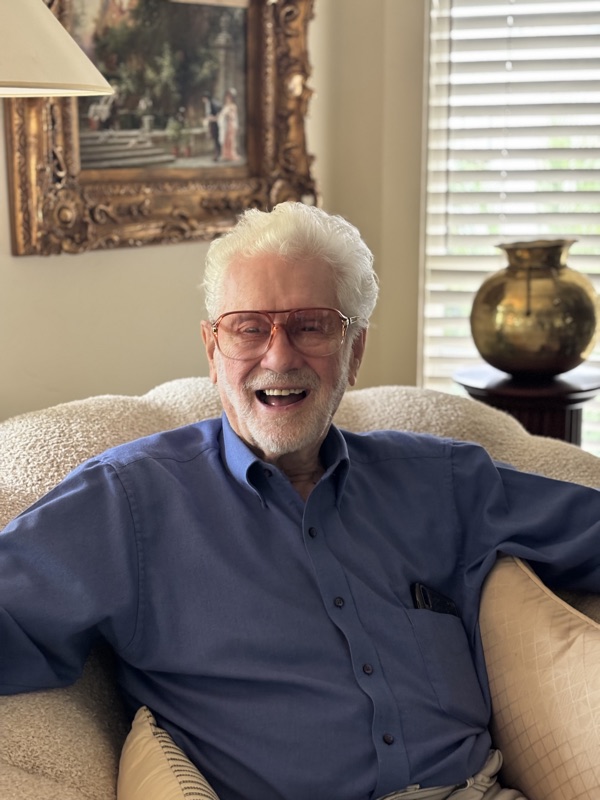
Reuel Minton
Voices of St. HelenaDylan Williams: I’m Dylan Williams, and this is…
Brandon Pham: Brandon Pham
DW: And I’m here with…
Reuel Minton: Reuel Minton
DW: on behalf of the St. Helena Historical Society [Oral History Program], in which we are interviewing at 10:07 a.m [April 12, 2026] at Reuel’s house in Yountville, California. To start us off, can you tell me when and where you were born?
RM: Well, certainly. I was born February 19, 1932, in the San Pedro Community Hospital in San Pedro, California.
DW: Wow. Now, I understand that 1932, that was the rock bottom of the Great Depression.
RM: It was.
DW: Can you tell me how that molded your childhood?
RM: Probably nothing since I was a tiny baby at the time. My first memories of that whole era, [came from] when I was probably around five years old. Other than that, I had just a normal childhood, and I knew nothing about being deprived. I knew nothing about being without anything. I always ate well, slept well, and had a wonderful, wonderful life.
DW: Amazing. What were your earliest memories of your childhood home in San Pedro?
RM: Probably, one of my earliest memories was my mother chasing me around a tree in front of the house with a broom, and because I’d been a nasty little kid, and we went round and around and around the tree, pretty soon she started laughing, and I started laughing, and it was a sweet mother-son relationship at the age of five.
DW: Sweet. Growing up in Southern California, San Pedro, Long Beach, what’d you do for fun as a kid?
RM: I’d say, let’s see… I would usually play in the backyard, [and we] found bottles of oil. I was feeding my sister, who was two years younger than me, a combination of oil and dirt, and getting her to eat my dirt/oil mixture, and I was a sadistic little kid. And we’d take many trips on the weekends, typically. We would go out to Irvine, Irvine Park in Long Beach. That’s where I was living in Long Beach at that time, and we were having a good time. In fact, that was a funny time for me later on. There were lots of grape vines hanging from the tree branches, and I started puffing on it [because] my dad showed me that I could smoke a grapevine because they were hollow in the center and you can light them at the end and suck in the smoke and do that just like a cigarette. So it was rather weird, but I got a kick out of that, and it was essentially, that was a fun time. Irvine, Irvine Park, and outside Long Beach.
DW: What role did religion play in your family’s household during your upbringing? If any?
RM: Well, it was a strong influence because I went to the Long Beach Seventh [Day] Adventist Church, and my grandmother was a heavy influence on my early life. And I remember my mother being baptized at the age of 30. And I was 10 years old at that time. And so I observed her being baptized into the Adventist Church, and it was a meaningful time to me. In fact, two years later, I became baptized myself into the Adventist Church, although I didn’t have that much of a background. Later on, it played a great part in my entire life. In fact, I’m still a Seventh Day Adventist to this time.
DW: What were your favorite family traditions or holidays to celebrate when you were young?
RM: I believe that we never had any specific traditions except for Thanksgiving. Thanksgiving was the great gathering of [the] family. I remember many times, we would have [the whole family] all the aunts, were in this [group], my great aunts and my grandmother, [and] there were five Smith girls. The Smith girls all stayed [together] pretty well, [and] tightly bound, and especially on Thanksgiving, we would meet together. The men would get together and usually talk politics, one of the family members was a Democrat and a couple were Republicans and a couple were reprobates. So I’m not sure how that played in my future life, but I always enjoyed standing around listening to them. I didn’t contribute anything in the way of politics or religion; come to think of it, religion never entered into the picture. Nobody talked [about] religion, but typically, it was a political discussion. We usually held it at my great uncle’s house, [he] had a great big house on a hill outside San Pedro, looking over the harbor, and he was actually the Health Commissioner from the city of San Pedro. And we enjoyed the meeting together. It was a great big house with lots of family.
DW: Awesome. And hearing talks of the war, World War II.
RM: Yes. World War II was a considerably talked about [in] discussion. In fact, just about the time the war started, there was a big [talk] about aircraft coming across the city of Long Beach. And I remember [hearing] anti-aircraft fire, [and] they thought they saw some enemy aircraft coming. Even though Japan was thousands of miles away, everybody was nervous about the war, and actually, we could hear when they were shooting the aircraft and the aircraft guns, the bombardment, all the fragments from the guns came pounding down on our rooftops, and it was a very, very interesting time to be living.
DW: In the questionnaire you filled out prior to this interview, you mentioned moving to a 40-acre farm at 13 years old in Lodi, saying it was a really good time in your life. Can you tell me what a typical day looked like for you working with the dairy grapes and walnuts?
RM: We had a diversified crop there. My dad had been a longshoreman, and it was a total difference from the 700 miles north to Lodi from Long Beach, California. My dad was a very creative guy. Unfortunately, the price of grapes went from thirty dollars a ton to five dollars a ton, and essentially, it was a total change of habitat for the whole family. We had moved from a very, very nice house that my parents had built in 1939, and to move into a converted chicken house, and because of the dropping grape prices, we had dropped from thirty dollars a ton to five dollars a ton [of grapes], and it was it was quite a change of lifestyle, and we were rich in Long Beach. Actually, we were [one of] the most well-off people on Long Beach because my dad was never unemployed. My dad had been a professional boxer, and he was a big guy, he was 6’4″, and weighed about 200 pounds, and all muscle. from working in the waterfront to [moving] into a place where we had essentially no money. We were the richest people on Long Beach when we lived two miles from the ocean front to the poorest people, probably, on Live Oak Road in Lodi, and it was quite a comedown from being well off to [being poor in Lodi]. You’ve mentioned the diversity. We milked cows, we had to augment our income because grapes weren’t worth anything, and my dad started a small dairy herd. Fortunately, I was about thirteen years old at the time, and so I learned how to milk cows. I milked eight, and he milked eight by hand. And so by the time I was a senior in high school, [well actually] that happened to be my sophomore year in high school, [where] I developed the best forearms in Lodi High School because of milking eight cows morning and night. So anyway, we also had walnuts, about five acres of walnuts. Our farm was, I think, either forty, probably around forty to fifty acres. And fortunately, we were able to diversify our living standard by picking walnuts, and as far as we have also about five acres of alfalfa, we would plant alfalfa hay, and we’d have a small ‘28-’29 Chevy, we converted to a mowing machine, and so we raise our own alfalfa hay, and we picked the walnuts. My dad always reminded me, “Don’t miss this walnut, they’re worth a penny apiece”. So we were very, very, very diverse, having walnuts, grapes, cows, and so forth.
DW: Awesome. You mentioned leaving the farm at age twenty for the army and never coming back. How did growing up with an agricultural upbringing mold the approach to your careers in the city and in real estate?
RM: Well, number one, I was probably one of the strongest people in my battalion. We had 200 people in my company, my military company. I started it at Fort Ord, and after they gathered about a thousand people together, this was all medical corps because I had been trained as an X-ray laboratory technician before I was drafted. My dad had said, “Look, they’re going to use you as cannon fodder in Korea, and you’re gonna be in the front lines, [because] you are a conscientious objector because of a religious belief”’. They threw many of those guys into the front line; out of 200 people in our battalion, 197 of them went to Korea. In fact, I was listening to my name, [because] they did it alphabetically, and they say “[Korea] A, Korea B, Korea C, Korea D,…” [and when they got to] my name, “Minton, New York City!”, so I ended up in New York City as an X-ray technician at the First Army Hospital, and it was a great duty, and I had a great time. I worked from 8 to 4:30, got a pass at 4:30 to get out and go into town on a very little five-minute ferry ride into this city of New York City, and it was an interesting experience because, [as] a farm boy, I had never seen anything quite like that. When I stepped off the subway at Broadway in 42nd Street, I stepped out and looked up, and there was the Marlborough man blowing smoke [rings], smoke circles, about eight-foot smoke circles, and it was a total difference from a farm boy.
DW: In your background notes, you mentioned your grandfather, Maximilian Anderoff, in which you noted his astonishing story about him being an ambassador in Russia to a surgeon and finally a mason in California. How are stories passed down to you as a child? And did you ever get to meet him?
RM: Well, I’d have to put that in sequence. Maximilian Anderoff was the son of [an] ambassador to Russia, the French ambassador to Russia. He was born in France, and then when the times got a little tough with Russia, the family decided to send him back to Paris, and he ended up in Paris, and then his parents were murdered by the Russians during this time. And when we were moving ahead, the family sent him from Paris to New York City. In New York City, he went to Columbia University and became a surgeon. And those years, in that time, usually medical school was like two years long, and he became a surgeon with two years of training. In fact, [while the surgeons] took off [limbs] they [would] run out of ether. You would [use it to] anesthetize all these guys that you were taking their arms and legs off, once they ran out of ether, they’d give them bourbon whiskey, and the bourbon whiskey would totally anesthetize them. And then when you ran out of those, they’d say, “Okay, bite hard on this bullet.” That’s why the phrase, “bite the bullet,” came into fashion. And there were many of them; he was lopping their arms and legs off. They threatened to murder him when they recovered. So, Maximilian was so fearful of them following him wherever he went, he decided to change his name. It was D’Angeroth. It was his name, and he changed his name to Anderoff and became a stone mason. He gave up medicine, and that’s where he lived. In fact, he’s buried in Satell Cemetery in Long Beach, California, on Sunset Boulevard. I’ve been to his grave, and anyway, that’s the story there.
DW: Wow. Yeah. What was your experience like in high school and college?
RM: I was a poor student. I despised the curriculum because I thought it was stupid, although in the summer of the classes that I wanted to show the people that I was a very smart kid, we came in last, and I liked geometry. We came to the very last geometry lesson, and it was the Pythagorean theorem. I remembered it was about 52 steps along, and I could remember it… The Pythagorean theorem. Stop this for a second. I’m having to think [for] a while, can you stop [the recording]?
DW: No, it’s okay, and we can continue. (Editor’s note: He could be referencing one of the many proofs for the theorem listed in Elisha Scott Loomis’s The Pythagorean Proposition, which was published in 1940, around the time he was in grade school.)
RM: Yeah, I’m just trying to remember, because it was since it was a 52-step [process] and I’m not going to give you all 52 steps. Well, anyway. I memorized the Pythagorean theorem. All 52 steps just to show the professor that was teaching the course that I wasn’t a total dummy.
DW: I want to dive into your track team and sports experience.
RM: Yes, yes. Well, I ran track in high school, and my best time was 50.1 seconds in the 440-yard dash. And that was about one tenth of a second behind the fastest guy, who went to Sacramento in the finals in the state of California, [who] did it in 50 seconds. I did it in 50.1 seconds, but I wasn’t in that track meet. I did that in high school behind the guy that won the track meet, and anyway, so the interesting thing about that is the fact that when I was drafted and went to New York City, and they ask if there’s anything special about my high school or college experience, I said, “Well, yes, one thing I can think of is I was on the track team.” They said, “Okay, you are now in the northern..’’ Let’s see, “you’re now in the New England track team for the US Army.” Well, I enjoyed being in the track team, and it took me away from being an X-ray technician all the time, and it was very, very interesting. But when I went… then, jumping forward in my career, after I’d ended up in a very significant part of [the] army. I was in France, and I asked the same question, “Do you do anything special?” I said, “Well, yes, I was in the track team”. Now they made me part of the track team for the Northern French track team from the US Army, and that had some interesting aspects to it too. One of which I was on the track team, and the coach of the track team, said, “Look, I’m going to put you, and you’ll be the backup man for the anchor lap, for the 440. So the four of us ran 440s, and the fellow who was taking my place, he got about 100 yards from the finish, where we were about 100 yards ahead of the other track games. He got a hamstring pull in his final 100 yards and fell over on the track. So we were out of the track meet, it was one time [thing], you do it, [and] if you miss, you’re taken out of the competition. So I said, “Oh, I have a two-week leave to go [because of] this track meet.” I jumped on the train, went back to my base, 90 miles east of Paris, got my civilian clothes, jumped back on the train, and it came back to Paris. Then I toured as much of Europe as I could, in that two weeks’ time. So anyway, that was an interesting part of the program.
DW: Sweet. And speaking of X-ray tech, when your dad suggested you go to a medical specialist school, can you tell me more about that conversation and your time and x-raying and school?
RM: Yes, yes. He said, “Bud.” Well, that’s my nickname. “Bud, I think that you don’t want to be cannon fodder for the Korean War.” No, I said, “No, Dad, that doesn’t appeal to me.” He said, “Well, I know of a commercial school in San Gabriel, California, that is called the California College of Medical Technologists. They are specializing in turning out an X-ray in a lab tech in about two years. So I went to that course, became an X-ray lab tech, and I got a job as an X-ray lab tech at the Camarillo State Hospital. That was the state hospital at that time, for there was a mental hospital. It was very similar to the one they have at Napa, the Napa State Hospital, which is a criminal hospital in Napa for the criminally insane. Well, one thing, [everyone at] Camarillo wasn’t all criminal insane. They had people who were trustees who walked around the grounds, and they would wash your car for a dollar, and they would take care of your needs. They’d iron your shirts if you liked, and it was a very diverse program. They had 5,000 women and 5,000 men. There was a large [field]– I call it the Alameda. It was a large football field in the middle of the whole thing, which I played many games of touch football on, and anyway, it was quite an interesting time for me [and] many of my friends. I was also going to Ventura Junior College, and I got a two-year AA [degree]there at Ventura Junior College. But it was a great time for me. I played many happy football games in the middle between the 10,000, 5,000 patients on the right and 5,000 on the left. It’s still in use now, and they converted that to the [CSU Channel Islands], I think. And so they have a great, nice California State College there. And I had many, many happy times there.
DW: And you played football in college?
RM: No, I didn’t play football in college. I [didn’t] play because all the football games were on Friday night. Since I was Seventh-Day Adventist, I observed the Sabbath, which is from sundown Friday to sundown Saturday, and so I didn’t do that. But there were many track meets held during the week, in our high school stadium, and then also the college situation. So anyway, I was a good quarterback. I could [throw] a football about fifty yards as a kid, because of my wonderful arms, I look like Popeye. And so anyway, I was a good physical specimen.
DW: Going back to deployment.
RM: Yeah, yeah.
DW: When you found out that 197 out of the 200 people in your basic training were going on the front lines, you were one of three. How did that make you feel?
RM: Delighted. I was totally amazed that I had escaped going to the front lines. Many of those friends of mine died in combat. And [there was] one guy in particular, his name was Jim Fisher. There were two Jim Fishers from Fresno. One was the Little Jim, and the other was the Big Jim. Little Jim was a litter bearer, and they had a G.I. lying on the stretcher, and they were carrying them across this place, and a mortar round came over and hit the litter, killing the guy on the litter and both Jim Fisher and the other guy on the other end. So anyway, it was a sad time for me thinking about them, but I was very, very fortunate that I was just in that situation. And yeah!
DW: How did that contrast affect your mind then going out into the front lines and you staying back?
RM: Well, I was happy that I wasn’t going to the front lines, and it made me think about my father’s [words]. He said, “Son, do you want to be a canon father?” Well, I escaped being cannon fodder. And it didn’t affect my mind, except for why I thought back to all those friends of mine. I had good friends and basic training, and they were all there getting shot up and whatnot. There were only the three of us that didn’t go. I was an X-ray tech and ended up at Camp Pickett, Virginia. I mean, excuse me, I ended up at Fort J Governor’s Island, and I was just thrilled to be there. But, I see as far as infecting my attitude, I was glad that, oh, I was [going to] say, one of the fellows, that missed going to Korea had a master’s degree in chemistry and he was working for DuPont Paint Company and the other guy who had to be a company clerk, and I don’t know how he escaped that, but anyway, three of us escaped duty in the service in combat.
DW: Mm hmm. And you were tasked with training medics, the skills they needed for the front lines. Tell me what a typical day of training them looked like.
RM: In what? And you mean in the basic training?
DW: Yeah.
RM: Are you talking about?
DW: When you were tasked with training medics.
RM: Oh, training medics. Oh, yes. That was when I was… The basic training! Yes, and I think the other reason I was picked was that I was the guy with the most education, and I taught a class of the 200 people called Materia Medica and Pharmacy. That’s where I gave them a course on how to fold bandages on the front lines, and I told them what [an] APC is composed of, and APCs or aspirin, phenacetin, and caffeine. Can you imagine a more boring subject than aspirin, phenacetin, and caffeine to listen to for an hour? And so I was glad to do that, and [they often] took me out [to] the lawn. When the GIs were all out doing the duck squat, picking up cigarette butts, I was walking around the compound with a clipboard and having a wonderful time.
DW: After your time in the military, you noted that you went back to college and spent 15 years in city jobs. Tell me about that transition back to civilian life.
RM: I had 15 years in X-ray work. And I was the first six years, I spent it at Cameron State Hospital, because they liked the fact that I was a good worker and I just the next my transition from the 15 years, 15 years was split up into two parts, and after I left the Cameron State Hospital, I went and I went back to college for a couple of years in Oxnard, California, and I spent a couple of years there, and then I went back to Riverside because I was going to go to medical school in Loma Linda, California. Loma Linda was the home of Loma Linda University Medical School. So anyway, you asked about [the] transition? Actually, I was in school for so many years. I had a family. I’d gotten married in the meantime and had two daughters. I was going to school full-time and working full-time at a hospital in Riverside. So anyway, I was busy, busy, busy all the time, and I didn’t have much time for anything else. I also had a part-time job. I developed a janitorial service, and I cleaned a bunch of offices in town.
DW: So what path did you take after your education and your part-time jobs?
RM: Okay. I was on the medical path [in college]. I was going to be an MD [because] I figured I was one of the smartest guys in town, and I didn’t have any problems with classes, but I didn’t realize that organic chemistry was such a difficult course, and I got a bad grade in organic [chemistry]. If you get a bad grade in organic chemistry, you’re not going to be accepted into any medical school. At that time, things have changed, and they’re suffering from [a lack of] medical doctors. I could easily get into medical school now, but not then. So I had a friend of mine who was an ER tech. He said, “You need to get into real estate. I’ve got a friend who’s in real estate.” I went, and I applied for a job with the best real estate company in town, and I got a job. And that job lasted for 60 years. So I was in real estate for 60 years. In fact, I still have a real estate license. If I counted the time I’ve been here, I’ve had a real estate license for 63 years. So that’s been my [life], and I’m not doing any real estate right now. I’ve had a stroke, and I’m living with my wife, in her lovely home, and I’m very happy here.
DW: What year did you start in real estate?
RM: 1963.
DW: So, you were riding off a large wave of expansion?
RM: Oh, yes. It was a good place to be in real estate. Highway 91 was coming from the Los Angeles area to Riverside. When they finished Highway 91, all of a sudden, that two-lane highway became a four-lane highway, and people started rushing into town. When I moved into Riverside, it was about 60,000 people. Now there are 360,000 people in Riverside, and they were building on every square block, and they [would look for] find [any land] to build any house that they could good up, and they were selling as fast as they could throw them up. My first house in Riverside was 1080 square feet. It’s a tiny little three-bedroom, two-bath house, and it was a terrific little space for a new family of four. But I lived there until back then, my next house, six years later, I moved into a two-story, three-and-a-half-story house [that was] about 3,000 square feet, and I lived there for six years. Then I sold that house, and I moved into another house, [where I] lived for six years. And then, my wife died in 2020. She died of COVID. It was December 26, the day after Christmas. And so I lived there down there for a couple of years, and my family said that the doctor had told them I was going to die from COVID. I survived, and when I got back to my house, my wife had gotten COVID, and she died about a week later. And so then I was at loose ends. My family was looking around for a place to farm me out. They found a place for $5,000 a month. I didn’t have $5,000 a month to spend for a house, so I said, “I’m going to have to look about it around for something else.” And I went to sleep, I prayed, “Lord, I need an answer”. When I woke up in the morning, all I could think of was CalVet. I looked up CalVet, in the state of California, Veterans’ homes, and I found the Veterans’ home right here in Yountville, and I contacted them. They said it would be about five years before I could get in, three to five years. I said, “That’s too long.” And then I called the man who was the financial administrator for our church. He said, “I have a friend in high places”. He called a friend, [who] was a representative in the state of California. He called me, said, “Look, you’ll probably get a call from the CalVet facility”. I did. They said, “Oh well, our time has changed. Now it’s three to five months, not three to five years.” So I decided to buzz on and check that out. I jumped on a plane, came up here to Oakland, came up here to the CalVet facility, and looked around, and I said, “Looks good to me.” They said, “Well, we’ll call you when there’s an opening.” I got back to Riverside. They called me in about a week and said, “We’ve got an opening for you.” So it pays to have friends in high places.
DW: For sure. And just backpedaling back to real estate.
RM: Yes.
DW: I just, I need to ask. With that economic expansion, how did that contribute to your company?
RM: Okay, well, I did this. You have to be in the real estate a minimum of two years to become a real estate broker and a higher [level] real estate salesman. That is exactly what I did. I opened her office. In my first office, I hired six salesmen, and then I did that again and again and again. I had six offices, I had 42 people working for me, and we bought the buildings that we were in, until we had a crushing real estate market. I closed the business, so they sold the business, sold the buildings, and decided to leave Riverside. That’s what I did. Sold my house, came up here, and that’s where I got hooked up with the CalVet home.
DW: You have three children?
RM: Yes, I do.
DW: Could you tell me the story of how you met their mother?
RM: Yes. I was in the military. I was in Fort J. Governor’s Island. The fellow [who] was running the X-ray department was also the projectionist for the island. So he taught me how to run a projector, [which] was the large 70 [milimeter machine], he taught me how to do that. And one day, I was visiting a friend of mine up there on my day off, and I looked, and there was a young lady trying to learn how to become a projectionist. There was an ad in the military paper saying they were looking for people to run the projector, [and] she was the most beautiful woman I’d ever seen. Her profile was gorgeous, and I was attracted to her. And so we got together, and then…(This is a part of the story)… I was called with the coveted commander on a Thursday, said, “Look, Private Minton, I’d like you to move my furniture for me on Saturday morning”. I said, “I’m sorry, I can’t move my furniture for you”. “On Saturday morning. And well, why can’t you do that?” I said, “Well, I can’t to do that because I’m a Seventh-Day Adventist, and I don’t do any necessary work from sundown Friday to sundown Saturday”, and he said, “Well, can’t you get special dispensation from your priest to let you do this work?” I said, “We don’t have priests and my religious program”. And he said, “Well, you do realize that you’ve disobeyed a direct order and you could be shot in a time of war. Right now, you could be shot for disobeying a direct order”. I said, “Well, so be it.” He said, “You mean to say you’re willing to be shot?” “Well, yes, I am. I believe, I believe.” So anyway, I went back to my bed, laid down and went to sleep, and the next day or two later, I got orders that I had lost my cushy job as an X-ray technician doing the X-ray [on] nothing less than Colonels. Colonels and Generals are very [strict] in [their] conditions. Anyway, I’d lost my job, and they put me in a barracks with 50 draft dodgers from New York City, so they woke me every four hours, and I took vital signs on the patients. It’s temperatures, pulse, and respiration, TPRs on all 50 every four hours. So I didn’t get any sleep all night long. And another week, they gave me orders that I was shipped out of the wonderful jobs that I’d had, and they had told me I was going to go to France. Now I’m lucky that that happened, because I [had] missed going to Korea as a combat soldier by one week. You had to have at least nine months left on your time [to be sent to Korea], and I had less than nine months by a week to go to Korea. So they shipped me to France, and I was in France for the rest of my service. And that’s when I got the [story where] when I was in France on the track team, the guy got his [injury]. He got a hamstring muscle [injury], and he fell over. Then I got my time to go, and we talked about that before, and I had a nice time in Europe. But anyway, so they shipped me back to the USA. My daughters started getting born. They were bangety bang, one, two, three. I had three daughters, and they were still all living, all married to their husbands, and I have about four [grandkids]. Well, one of my granddaughters was murdered by a guy who was a drug dealer, and the other one of my grandsons was an electrical engineer. He was in the Army when [we went] into Afghanistan and survived [while] the guys on both sides of him and got killed, and so anyway..
DW: So, transitioning to your Napa Valley lifestyle through CalVet, you listed your current spouse, Esther Peach Nittle.
RM: Yeah.
DW: But since you moved to Yountville a few years ago, could you share the story of how you two met later in life?
RM: Yes. I was in the Veterans’ home at Yountville. It was the California Veterans’ Home [in] Yountville. And since I was Adventist and still an Adventist, I decided to find a church close by. I went to the church, which was within five minutes of my house. I moved into [the] veterans’ home. My room was a 15 square foot house. I had one bed, a chair, a table, and they told me I couldn’t bring any furniture or anything, but I found out that I could bring a bookcase, so I have a great, big oak bookcase built by La Sierra University in 1922. I disassembled it completely and put it in the back of my car. I had bought a new car, a newer, nicer car, and it was big enough, just to store the bookshelves crosswise in my car, Caddy Cornered in my car. Anyway, I brought that up with me and smuggled it into my room as my first piece of furniture. And so I was also able to squeeze in two rocking chairs. One was brought across the plains of Kansas, [which] belonged to my grandmother, the one who had the greatest influence on me, reading me the book called The Great Controversy, and The Great Controversy told the fight between God and Satan from 7 AD into the present time. And so I had a rocking chair that belonged to her. I had another rocking chair that belonged to an ex-client of mine, and I took that and fixed it all up fancy. Anyway, I kept those two chairs with me, and it was a good thing I did because I had two nice chairs in my room. And anyway, I went, and I’m scatter shooting here. I went to three churches, the church in Yountville. Adventist churches, and the church in Napa, the church in St. Helena, and then the church in Pacific Union College, and then I did that again to make sure I was not making a mistake, and that’s what I did. I went again, and I found that the Yountville church was the best of the bunch, and I started looking around at the people. There were probably about 100 people/members in a small church. And one day I saw a beautiful blond woman down there in the middle of the church, and as I was eating, they served potluck, and as I was eating [food from the] potluck, suddenly a cookie appeared in front of my face on the table, and then I looked back, and there was this beautiful blond woman who was walking away. So I was attracted to her, she was attracted to me, and within three months, we were married, but anyway, that was it. Is there anything else?
DW: Yeah, I’d like to talk about, with your expert background in real estate, you noted that the land prices here cater only to the richest. How do you feel this economic shift is changing the character of Napa Valley and its community?
RM: Well, Napa is impossible to find anything that’s reasonably priced. Napa Valley, you can’t find a house for less than a million dollars in most cases; there are some inexpensive houses for people who need housing. That’s through, essentially a mandate for the city council that you have to have so many houses for people who are poor people. And that’s essentially… [why] you just can’t find any [cheap places]. The cheapest lot in Napa is one million dollars. I should say, in Yountville, [they are] one million dollars. There are probably $500[,000]-$800,000, which means that all the houses in Yountville and Napa are very, very expensive. It’s only the rich can afford a house.
DW: Yeah. What are you most proud of in your personal life?
RM: I stuck through the job for sixty-three years. I’ve enjoyed my life, personal life. Let’s see, I’m glad that I had a… I’m thrilled that I had a good grandmother. [A] grandmother who took the time to sit down with a rascal like me, and talk to me about Jesus and him crucified, and that was the bedrock of my life. It was needful for me to have that bedrock, and I have never deviated. Oh, I’ve done the typical junior stuff. When I was in college, I was a smoker and a drinker, and I [stopped] after I got out of there. I never smoked or drank again. And it contributed to my good lifestyle, and since I’m ninety-four years old right now, it has not hindered me at all. Unfortunately, I had a stroke about eighteen months ago. It hindered my activity. I was a good golfer, too, and I enjoyed that. I enjoyed sports of all kinds. When my health was good, I played basketball for thirty-five years, so anyway.
DW: Well, unfortunately, we’re out of time, but is there any advice you have for future generations of Americans listening to your story?
RM: Certainly. Find a good woman, get married, have children, and buy a house. The next thing is, don’t drink or smoke, and have good health habits. And watch what you eat, I can advise you about that. I have a good diet. Lots of vegetables. I used to be a vegetarian. My wife convinced me that I need a little bit of protein. And other than that, I mean, I’m living a good life. I have probably lived a better life ever since I’ve been in this household than at any time in my life. I’m more happily involved in life with my wife right now than I was ever involved with anybody else. Even my first wife, she had a different religion than mine, and I wouldn’t advise that because it takes too much adjustment, especially [since] Adventism is a strange, different lifestyle. No one goes to church. When I say nobody, [only a] very few people go to church on Saturday, the seventh of the week, although it’s mentioned thousands, hundreds of times in the Bible, and the Bible [is] my manual, that from sundown Friday to sundown to Saturday [is the Sabbath], and [in] the very first book of the Bible, Genesis, Moses [is] in the beginning [on] the first day, and they created such and suchs. And you go right through the six days of the week, and that’s essentially the creation day, and God rested on the seventh day, and blessed the seventh day, and we should all do the same thing. He said, “Remember the Sabbath day to keep it holy”. But then, other than that, I would say it’s a good lifestyle for anybody. You’ve got to love God. You love a human man, human beings. Whoever they are. Love God and love your fellow humans.
DW: Well, thank you for having us, Bud.
RM: Yeah, well, I was kind of jumpy, jumped around all over the place, but I thank you for the opportunity.
DW: Mm hmm.
RM: You’re going to have to clean that up. I’m sure.
DW: Just a little bit.
RM: Yeah.