
By Mariam Hansen, St. Helena Historical Society.
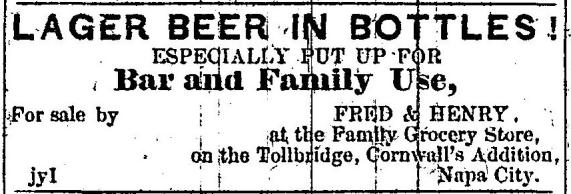
Beer is a necessity of life. This was especially true in 19th century Napa Valley when the drinking water was not like it is today. In 1857 Fred Bender & Henry Schwartz were selling lager beer in bottles in Napa City. Butler, Delhanty and McGarvey’s Napa City Brewery was selling cream ale in Napa in 1862. German Gotthelp Barth’s 1867 ad notified the public that he was selling Gundlock’s Bavarian Brewery bock beer at the Napa German Hall. He built a new brewery in 1880, making 1,000 gallons a day.
The 1881 History of Napa & Lake Counties states that 63,500 gallons of beer were made in Napa County in 1880. St. Helena Brewery was built in 1870, according to historian Lin Weber. By 1874 500 gallons of beer a day was made there by German Edward Fautz. The brewery was located on Spring Mountain Road just past the York Creek Bridge. At that time the road was called Brewery Lane.
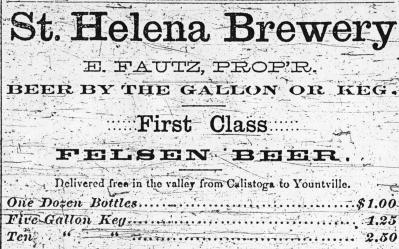
On Oct 31, 1972 Edward Fautz became a US citizen in Sacramento. He is listed in a city directory as a brewer, working for Sacramento Brewery. The next year he left Sacramento, came to St. Helena and bought the St. Helena Brewery from George Ebert. Louise Zimmerman became his bride and their son Edward, Jr was born around 1880.
Napa County produced 68,000 pounds of hops in 1877, crucial to making beer. Edward Fautz and Leopold Wert were listed in the 1880 census at the same address as brewers—both from Baden, Germany. Wert came from brewing in San Francisco and lived with the Fautzes. Eggert Girau of northern Germany also worked at the brewery.
The Fautz home on Brewery Road/Spring Mtn Road burned down March 24, 1879. Cause was unknown. The house was a story and a half with 8 rooms. In July 4, 1891 antics, boys lighting fireworks nearby started a fire which almost burned the brewery. The fire burnt 200 acres.
The German Turnverein Vintage Festival visited the brewery Sept 14, 1891. The “resort” had been decorated for the special German guests by Mr. and Mrs. Fautz. The revelers “whiled away the hours by bowling, singing and drinking.” A year later a new ad came out for “Felsen steam beer and Porter”.
The business was in jeopardy when Edward Fautz died at age 48 on July 21, 1892. The inventory of his estate lists the assets: Two brewery wagons, 300 beer kegs, 300 boxes, 3600 bottles, brewery machinery, a safe, one phaeton, one spring wagon, four horses, harnesses, plow, and a cultivator.
Louisa Fautz was known as a “stirring business woman” She kept the brewery going by leasing it to Emil Wackerling. She bought 20 acres in Yountville near the entrance to the Veteran’s Home and built a saloon, restaurant and summer garden. This caused a conflict with the home manager in 1894, when the home residents boycotted their canteen over a decision to withhold residents’ pensions. St. Helena Brewery beer was not allowed at the canteen, so Mrs Fautz retaliated by luring home residents to her saloon nearby. The Veterans home said they were protecting veterans from “designing creatures”. On Sept 11, 1895 the St. Helena Brewery burned to the ground. No beer was made there again. Not long after on Nov 7, 1895 Louise Fautz died at the age of 50 after a long illness. She left her property and a small fortune to her son Edward.
George G. Daeweritz was born in Germany and came to this country in 1881 and located in San Francisco, where, he found employment in Wieland’s Brewery. After several years he became brewmaster of Jackson’s Brewery and live years later occupied the same position the California Brewery. On July 3rd, 1894 he married to Emilie Riessau in St. Helena, whom he had met in San Francisco and the couple moved here.
“George Daeweritz is arranging to start a brewery in St. Helena early in the spring and has three buildings in view, any one of which could be easily converted for use in such an enterprise. It is Mr. Daeweritz’s intention to put in a first-class plant and make as good a quality of beer as can procured anywhere in the state” reported the St. Helena Star on Jan 7, 1898.
George took the St. Helena Brewery name. He asked the city council for permission to erect a stone building on Hunt for his brewery. Upon motion, it was granted. He planned a stone building next to his saloon on Hunt Steet that would be 30 feet by 30 feet in size. The apartment in back of the saloon will be converted too. Stonemasons are Battista Maggetti and C. Martin, with stone from Dr Davis’ quarry. The first brew was done July 1 and George delivered it in his newly custom-built wagon. A few months later was fined in Calistoga for peddling beer without a license and fined was $25.
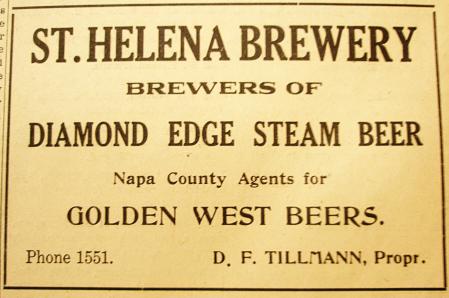
Competition came from Rainier Beer. St. Helena Bottling & Cold Storage was founded by Ewer, Anderson, Cook and Sink in 1905. Shipped from Rainier in Seattle to St. Helena by rail in carload lots, each barrel contained 31 gallons. It was bottled at the facility on Madrona at Spring Mountain Road (that odd building). George Daeweritz died on July 10, 1913. The following year his wife Emelie sold St. Helena Brewery to Dominic Tillmann, the agent for Golden West Brewery of Oakland. Tillmann added a large delivery truck to the brewery equipment. Tillmann began to advertise St. Helena Brewery’s “Diamond Edge Steam Beer”. The city council granted a liquor license to the brewery saloon on July 3, 1914.
Dominic Tillmann was born in Germany and came to America as a young man. He settled in Oakland, where he became a close friend of Theodore Gier, a Napa Valley vintner. Dominic purchased a ranch on Howell Mountain, but later moved into St. Helena. He moved back to Oakland when Prohibition started.
At midnight November 30, 1918 all breweries in the US closed down by order of the president. Making beer required wheat and barley, which was in short supply and must be used to feed the people, was the argument. There were 53 breweries in California affected by the order, including St. Helena Brewery.
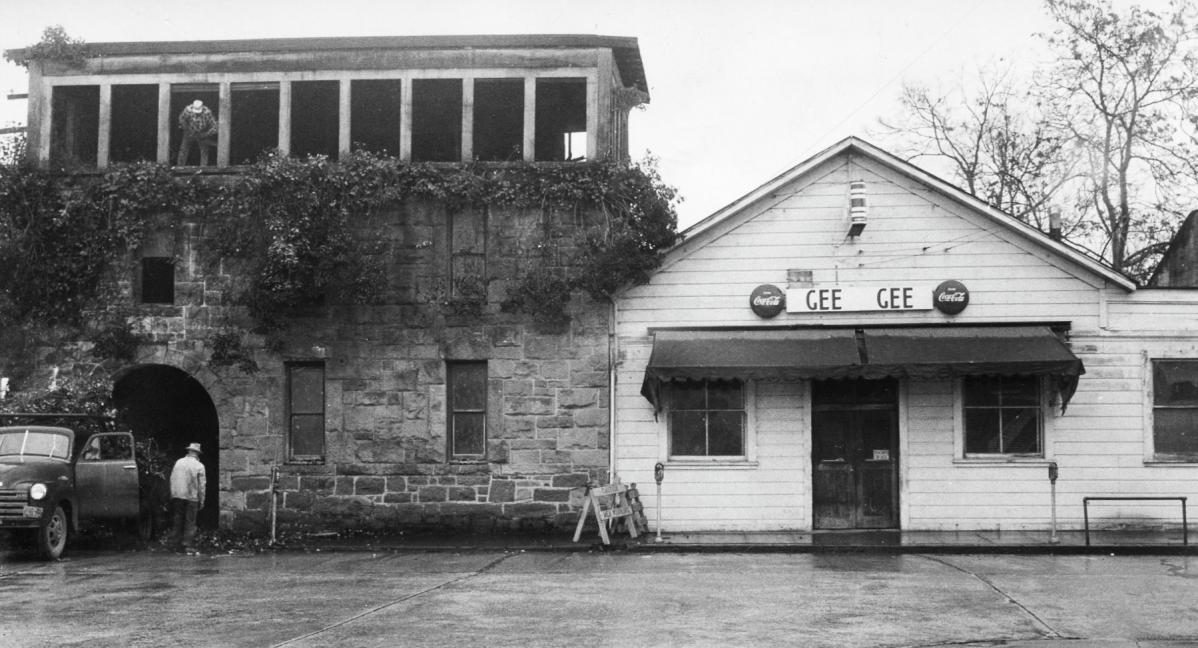
In 1923 a Prohibition raid caught Felix “Gee Gee” Freilone with alcohol at the “Old Brewery” Saloon. A week later he bought the business from A. Bruno, who moved to Calistoga and was arrested selling liquor there. While Felix owned the saloon business, the Tillmanns owned the property.
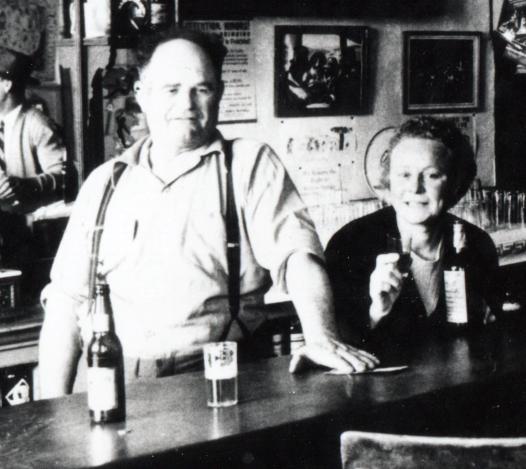
St. Helena Brewery equipment was still inside the building: a cooler, mash tub and kettle. In May 1933 Mr. Tillmann brought an investor to town with interest in re-opening the brewery. The ghostly building had been shuttered since 1918. Later in that year Mr. Tillman died and in 1935 Mary Tillman sold the property to Helene Paetsch. Gee Gee’s continued to operate—legally now. Prohibition ended in December 1933.
Dano & Shirley Mattiuzzi bought the property from Paetsch in 1957. They demolished the brewery and Gee Gee’s Saloon in 1958. A caterpillar pulled the soft stone walls down. Amid a cloud of crumbling stone, old square nails were found inside. Frank Creasey bought the stones. The Mattiuzzis built a new cocktail lounge, naming it Dano’s. That was the end of St. Helena Brewery.