
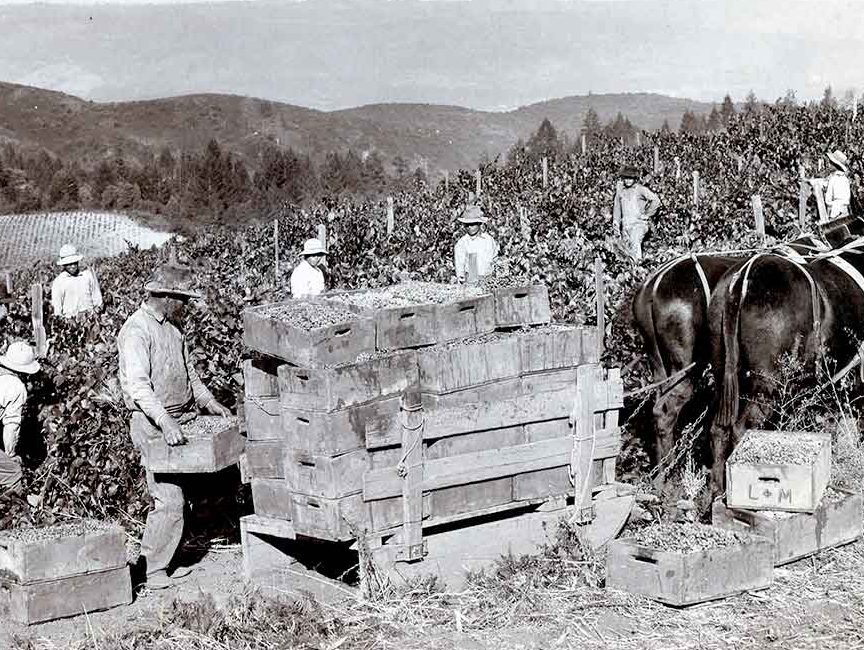
In 1858, John Patchett of Napa asked Charles Krug to turn his grapes into wine. Krug showed up with a small cider press.
He made 1,200 gallons. When Krug died in 1892, the St. Helena Star wrote that the wine “was the first ever made in Napa County, other than by the old Spanish process.”
Before the Gold Rush, the Star wrote in 1878, valley wine was made “in the crudest manner in mere driblets and, according to the old Spanish custom, was manufactured and stored in cowhides.”
Krug was born in Prussia in 1825. In 1848 he joined a failed attempt to overthrow the German parliament and spent nine months in jail. Later he edited the Staats Zeitung, the first German-language newspaper on the Pacific Coast.
He kept making wine for other people. In 1860 he made 5,000 gallons on shares at George Yount’s farm. At the end of that year, he married Carolina Bale, daughter of land-grant holder Edward T. Bale. He was 35. She was 18. Her dowry was 540 acres.
The first crush on the Krug vineyards came in 1861: about 100 gallons, from Knights Valley grapes. By the time he died, Krug had 150 acres planted and a stone cellar that held 300,000 gallons. Over 100 carriages followed his hearse.
The wrong grape
Looking back in 1878, the Star wrote that in 1861 “everybody rushed pell-mell into the business.” They planted the Mission grape. The same article called it “a mistake that has only been rectified after years of labor and vast expenditure of capital.”
Dr. George Crane planted the valley’s first vineyard of European grape varieties, and it came into full bearing around 1867. Wholesale planting of European grapes began in 1867-68. Growers handed out cuttings to newcomers for free.
In 1870-71, Mission wine “proved almost worthless.” Wine shipped east was “comparatively unsalable.” San Francisco’s moneymen, the Star wrote, “had ever regarded them with suspicion and now were shyer than ever.”
It took until about 1876-77 for St. Helena wine to find “much more ready sale.” By 1878 the Star was bragging that the district “stands head and shoulders above any other wine-producing district on the continent.”
That year the district made nearly a million gallons. Scarcely 75,000 came from Mission grapes, and those went into brandy. The biggest producer was Krug, at 225,000 gallons.
The cellarmaster from Mainz
Jacob Beringer was a cellarmaster from Mainz, Germany. He took the train to St. Helena in 1870 and went to work as cellarmaster for Krug. In 1875 he bought land for $14,500. He made his first crush in 1876 while still working for Krug.
At the time, most of the labor for winery and vineyard development was done by Chinese men. At Beringer, Chinese laborers cut the tunnels into the hillside with picks, shovels and blasting powder.
The winery’s cornerstone was inscribed “B.B. 1877.” Sealed inside were a copy of the Star, a $20 gold piece, and bottles of native wine and Champagne “for future generations to sample.” The Rhine House was finished late in 1884.
St. Helena incorporated March 24, 1876. That same year phylloxera, “a plant louse that is a pest of vines,” was recognized in the valley. One early remedy was iron filings around the roots. By 1893, half of Napa Valley’s vineyards were infested.
Greystone and the sheriff’s sale
Greystone Cellars went up in 1889, built for William Bowers Bourn II as a cooperative wine cellar. In 1892 Dowdell & Son leased it. At the time it was the largest winery in the state.
In 1895, after a fight over a loan, the Dowdells’ wine went to a sheriff’s sale. Its 363,000 gallons brought $41,234. Dowdell & Son never made wine again.
Christian Brothers ran Greystone as a winery from 1945 to 1989. Today it’s the Culinary Institute of America.
Gravel in the tanks
Prohibition took effect in 1920. Most wineries closed unless they made sacramental or kosher wine.
“They had to shut the wineries down except Beringer and Christian Brothers, which still produce sacramental wines only,” Kenneth Grant Cairns said in his oral history for the society.
Growers shipped their grapes east instead. “At one time they shipped as many as 100 railroad cars a day out of St. Helena,” Cairns said. His grandfather ran a grape-shipping company.
Marsha Bettinelli described a warning chain among growers: “When the government people would come to inspect if you were making the allowed amount of wine, there was a system where the farmers would notify each other that they’re coming.”
George Vierra passed along a story he’d heard about Prohibition-era wineries. They “used to take gravel and put in the top of the redwood tanks, so when the revenuers came around the tanks from the top always looked full.”
“I think everybody had a still,” Ernie Butala said.
Repeal came Dec. 5, 1933. Louis M. Martini Winery was founded that same year. Mary Edano said Martini “was one of the first ones to start something after prohibition.” Her father got a job in his vineyard. “It was a life saver,” she said.
Krug goes to the Mondavis
In 1943 the Mondavi family bought the Charles Krug Winery, where Jacob Beringer had once worked as cellarmaster.
Robert Mondavi left the family winery in 1965. In 1966 he opened Robert Mondavi Winery. Wine Spectator says it was Napa’s first new winery since the late 1930s. Crushing began before construction was complete.
Since 1981, the Napa Valley Wine Auction, held at Meadowood, has donated more than $230 million to local healthcare, youth education programs and affordable housing. Programs, passes and paddles from the auction are on display at the Heritage Center Museum, 1255 Oak Ave.
Holding the valley floor
In 1968 Napa County supervisors passed the Agricultural Preserve ordinance.
“That is what keeps this whole valley from being turned into subdivisions,” Darrell Quirici said in his oral history.
“We got the Ag Preserve passed, and that was a great battle,” Sloan Upton said in his oral history. “And we still have to battle it today.”