
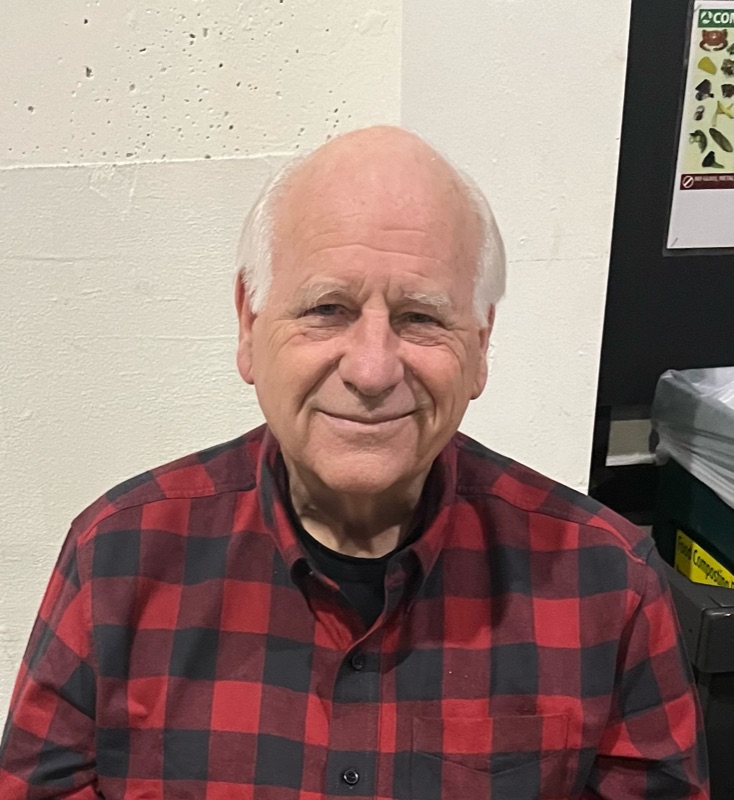
Don Buller
Voices of St. HelenaAda Blanton: This is Ada Blanton,
Lillian Grimes: And Lillian Grimes
AB: And I’m pleased to welcome,
Don Buller: Don Buller.
AB: Who I am interviewing on behalf of the St. Helena Historical Society’s Oral History Program. We’re conducting this interview at:
DB: 945 Champion Lane, Deer Park.
AB: [On April 19, 2026] At 7: 39 p.m. Welcome, Don. Can you begin by telling us where you were born and when you first came to the St. Helena area?
DB: I was born right here, down at the St. Helena Hospital, on December 1, 1950, and so I’m the third generation here in the valley.
AB: What are some of your earliest memories?
DB: Well, we had a pretty free life when we were kids and did a lot of running around and exploring. There was a big cave over here [near Deer Park Rd] that was on the property belonging to the hospital, and that was a favorite place to explore until they blew it up to keep people from going in it. And we had a lot of friends. There were a lot more kids back then. We were in the baby boom after the war, so we had lots and lots of friends. So we mostly, you know, all went to the same school, same church, the same clubs, our dads were in investment groups together. And so it was a pretty close-knit group back then.
AB: What was St. Helena like when you were growing up?
DB: It was, you know, from a building standpoint, the main street was not unlike it is now, but the businesses were different. They were all pretty much things that the locals there had: a Five and Dime store [where everything was 5-10 cents], and there was, of course, a hardware store, a drugstore, and a couple of clothing stores. And because my great-grandfather, my grandfather, and my dad were all in business, everybody knew them. And so when I was a kid- after kindergarten- I’d go over to the office, and I’d run around, run errands and stuff, and everybody knew me. So, you know, for a little kid, it’s nice, you know, [imitating other people] “Hey, you know, how you doing, Donny?” So, you know, we’re at Steve’s Hardware. Steve’s Hardware was next door to the office, and the Five and Dime was across the street, and the Model Bakery was over there, and I discovered that my favorite was maple bars. I would do chores to earn a dime for a maple bar. But yeah, it was a pretty friendly town. And one difference then was, you know, you could afford to water a lawn, so everybody had a lawn. Nobody could afford to water one now.
AB: What do you remember most about going to elementary school at Foothills?
DB: Well, I went to kindergarten down in St. Helena first. So that was pretty memorable for me, my first experience at school. And then after school, I would go over to the family office, and they would all take off and leave me at a desk. I didn’t know how to write or anything, but people would come in, and I would try to draw pictures of what I thought their names were, so I could remember to tell them who came in. One time, we had a show and tell at school, and so I took my cat, Fluffy. We always had rest time. We’d put our mats down and have rest time. And so, Fluffy was wandering around, and all the kids went “Here, kitty,” and tried to get the cat to come over to the mat. And the teacher said, “No, do not call the cat.” Well, this kid next to me kept calling him. So my cat walked over there, and we always took our shoes off and put them by the mat. The cat sat down in his shoe, and when he got up, his shoe was full of cat poo [laughter]. And so the teacher was not happy about that. He wasn’t happy about the kid calling the cat, but he wasn’t happy about me bringing the cat and sent a note home, “Please don’t let him bring his cat again.” So that was my most memorable experience at kindergarten. And then growing up at Foothills School, the school was pretty old, you know, it started in 1902, and still a little bit primitive when I was there because they had a merry-go-round and swings, but not a developed playground like they do now. So our big play area was the creek that ran through the property in the woods that were there. So we went down to dig clay out of the banks, make dams, and breed polliwogs to take into the school. Our teacher- we had this neat teacher- our first-grade teacher was the neatest. She was, like, four feet tall and perfectly round. We were almost taller than she was -we really loved her- she was very calm but very firm. She had a rule: stay out of the creek. You can play in the creek, but don’t get wet. And if you get wet, you have to wear this ugly green dress the rest of the day. And so we were really careful not to get in. Well, one day, Freddy Baldwin fell into the creek and got wet. And so he had to wear the green dress the rest of the day, I think it affected him for life [laughter]. Then we had this other kid, Norman Newton, who lived down in the woods below us. He was from a very poor family. His mom worked in janitorial at the hospital. He’d invite me over for lunch, and his mom was there, she was squeezing dog food out of the end of a can, slicing it off, and making burgers out of it, frying them up for lunch. He would come up and eat our dry dog food. [Imitating Norman Newton] “Man, your dry dog food is so much better than ours.” Well, Norman didn’t mind very well. And so one day it was really hot, and we were playing in the creek. Norman said,” I’m going in the creek.” So he took his shoes off. And we said, “Norman, Norman, no, no, no, no, Norman, don’t do it.” But he did. He took his shoes off, went into the creek, and he was making us all feel bad because it was like 100 degrees. He said, “Oh, this mud feels so good, this clay-” It was all clay on the bottom- “It feels so good.” All of a sudden, he screamed, jumping out of the creek, his foot was bleeding, and he’s like, “A Crab got me, a crab got me!” Well, actually, he stepped on a piece of glass, and his foot was bleeding. He had to go over to the hospital and get stitched up. But boy, I tell you, that was a lesson to mind our teacher. But no, we had a fun time down there. It was pretty simple, but fun and probably more fun than the kids have now.
AB: Can you tell us about your grandparents?
DB: Well, yeah, my Grandfather Jenkins, he’s the one who was in real estate [see Image 2]. He and his father had a real estate business, but during the depression, he and his father had owned and ran a hospital up in Jacksonville, Oregon. During the Depression, they lost it and lost the farm and everything. So the whole family moved up to Canada and homesteaded a place [on Adams Lake] that was way up in the boonies, like it was forty miles from the nearest road. They had to go by boat across the lake, and they lived there for several years. My mom grew up there, and they had a lot of experiences. I mean, they were real survivalists and lived off the land and out there, but when he eventually settled in St. Helena, he got into insurance and real estate, and his father worked with him. In about 1949, I think it was, my great-grandfather was showing property out on Ehlers Lane and stepped onto some old boards, which were over a hand-dug well, and fell down through the boards and hit his head and drowned before they could get him out. I never got to know him because it was a year before I was born. My grandfather was an extremely hard worker and would work at his desk until he took a break for lunch. He worked all day until eleven o’clock at night, and then walked home. Well, to save walking home, he ended up buying the office that I have now, on Main Street, which has a living area upstairs. And so at eleven o’clock, when he wanted to go to bed, he just had to go upstairs instead of walk up the street to go home. But he was a very hard worker and expected me to put in the hours that he did, which I never did. I liked a little time off now and then, but he worked hard and played hard; he had a lot of life experiences, and every time we got together, he had story after story that he could tell about his adventures and things that he did. My other grandfather was a [potato and cotton] farmer and lived down in Shafter, and had four boys. They all grew up on the farm, and then when the war came, they all got drafted, except the youngest one, and all went to war. After the war, they gave the returning soldiers part of the GI bill, which gave them money to pay for their college education. And so they sold the farm down there and moved up here so that the boys, there were four of them, all went to PUC and got their college degree up here, and that’s how they ended up here. But my grandfather, after he left the farm, loved working on watches. So he had a little jewelry shop that was actually next door to my other grandfather’s real estate office. And so they got acquitted. My grandfather on one side had three girls, and my other grandfather had three boys, so they started having picnics together, and then my mom and dad eventually got together.
AB: What was it like growing up with your father in the military?
DB: Well, I actually didn’t, because the war ended in 1945, and he probably stayed in for maybe a couple of years after that. He was drafted, and so he went in as a medic. They were planning an invasion of Japan and expected a million casualties. They told them that nine out of every ten would probably be killed because the Japanese were just so persistent, they just wouldn’t give up. And so he was on this invasion ship with thousands of other guys that were going over there. Just before they landed to do the invasion, the Americans dropped the atomic bomb on Hiroshima and Nagasaki, and ended the war. The American military made a very, very brilliant move because the Japanese considered the emperor like a god; they would do anything the emperor told them; they’d die for him. So they got together with the emperor and said, “Hey, Mr. Emperor, here, let’s make a deal. You know, we’re going to help you rebuild your country, but we want to be friends. So you tell your people to lay down their arms,” and so he did. They all laid down their arms. The hardest thing for the Japanese at that time was turning in their samurai swords, because these had been handed down for generations and generations. But they were considered weapons, so they had to hand them in. And so they had these big piles of samurai swords, and all the soldiers got to take souvenirs. My dad brought two home with him, which I have. Then, the emperor told the people, “Treat the Americans like conquering heroes.” And so they just treated them so well, the soldiers. And so it actually turned out to be a really pleasant experience [for my Dad]. [He was there with his friend Dudley Galusha, who was also a medic] While there, they got acquainted with a Japanese lady at church. She had two little girls. Her husband had been a Japanese soldier and had been captured by the Americans, and so they were marching them along, and the Japanese soldier, he was a Christian who had a Bible in his pocket, and wanted to show that he was a Christian. So he reached into his pocket to pull out his Bible, and they thought he was going for a gun, so they shot and killed him. So this lady was left with two little girls, and so the soldiers [my Dad and Dudley] tried to help her the best they could. About 15 years later, my dad was in church with Dudley Galusha, who had both been over there in Japan at the same time, and somebody came up and said, “There’s somebody who wants to see both of you. And so they went down, and here’s this lady from Japan. She had bought her two girls over to go to the school at PUC. She had remembered my dad’s name and Dudley Galusha’s name and wanted to see them again, so that’s it. Anyway, so I didn’t really grow up while he was in the military, but he had stories that he told about their training and experiences in Japan and stuff like that. They liberated some of the Americans from the Japanese prisons and things like that. So it definitely kind of, you know, it was fresh on his mind because the war ended in ‘45, and I was born in 1950, so it wasn’t very long before, you know, I was old enough to want to know about it. And he told some of the stuff that went on in there.
AB: Did your mother ever tell you stories about her life?
DB: Yeah, she did, because she grew up in her early life until she got to be about maybe mid-grade school age. She lived in this log cabin up in Canada. She and the five kids, four siblings, and her parents all lived in a one-room log cabin, no running water, no electricity, and pretty much what they could hunt and grow out there. They got their water from a spring, and during the winter, you know, they had to go out and break the ice to get water. And sometimes the snow got clear up to the rafters, eaves of the house, they didn’t see the dirt for at least six months out of the year. She was the oldest, so she basically helped raise the younger kids up there. And a lot of interesting stuff, you know, they had pets that they’d caught. They had a pet raccoon. Well, they had nothing to feed the raccoon; they weren’t going to feed it people’s food. And so they had to catch blue jays to feed the raccoon. And the way they caught the blue jays was they set mousetraps out on the porch and threw grain out there, and when the birds came down to pick up the grain, they’d get caught in mousetraps, and they’d feed them to the raccoon.
LG: Wow.
DB: But you know, they had bears up there. My grandmother shot a bear, you know, from the cabin window. And I’ve got pictures of the bears on the side of the log cabin up there, but it really kind of affected her early life so that she was always very satisfied with whatever she had, because it was so much more than what she’d grown up with.
AB: What was it like being a football captain at PUC Prep?
DB: Oh, well, it was kind of a title I had, but it was after a humiliation that I had. I thought I was a pretty good football player. And we had a coach and an assistant coach up there that were our teachers, and they were guys that were really, really respected, and so they were putting together an all-star team one time, and they were doing tryouts for it. Money was really tight, so I never could afford a pair of cleats. And most of the other guys had cleats. So one day, when they were doing the tryouts, and it had just rained, the lawn was slick and wet, and I was slipping and sliding, and I didn’t make the cut, and I was just devastated. So I asked him [the coach], ” Why didn’t I?” He said, “Well, you just looked a little uncoordinated out there.” Oh, man, I was so embarrassed because I thought I was, you know, one of the good players that I just doubled down, tried extra hard. I think I found a pair of cleats at the Goodwill or something and ended up, you know, by the time I left, I was voted Sportsman of the Year and captain of the football team and all the rest of it. So it was kind of a bragging right type of deal, you know, to impress the girls. It was all about cars and girls back then.
AB: How’d you get into real estate, and what’s kept you in that field?
DB: Well, interesting, you should ask. See, when my dad graduated from PUC, up here, he graduated with an agriculture major because he’d grown up farming all his life. He was going to go into farming. Well, my grandfather invited him to join him in the real estate business. He had married her daughter, and so they were starting a family, so he’d joined him, and then I’d never planned on going into real estate. I had always wanted to do something else, but I took a business major, not knowing exactly what I was going to do with it. And so my dad, when I graduated, he said, “Well, why don’t you, just for fun, why don’t you go ahead and get your real estate license and work here and tell you figure out what you want to do.” And so okay, I did. It turned out I enjoyed it, even though I was really shy of strangers. I didn’t really like meeting strangers, but I got used to it. And so that’s how I got into it, I was the fourth generation in real estate. But see, my grandmother was also in it, and so it was my mom, so it was a whole family business.
AB: How was your career affected by the area we live in?
DB: Well, I think we were extremely blessed because I got into real estate when I graduated in ’74, and prices, you know- the interest rates- we were in the Carter administration, and interest rates were really high, 21% for interest on a house. It was a tough market, but we still made it. People still bought houses, even though it was really expensive. But then Reagan came in, and kind of turned everything around, and we ended up going into a boom that lasted 15 years. And with that, the real estate market took off. My dad had always drilled into me that I needed to buy real estate, so I bought my first house while I was in college. And so from an investment standpoint, it was like, everything was just going crazy. It was easy to make money by investing in real estate, because almost anything you could buy you could guarantee was going up in value.
AB: What was it like being involved in the community, like with the Rotary Club or Pathfinders?
DB: Well, I was part of the Pathfinders. Pathfinders was like the veggie version of the Boy Scouts. It was a kind of church-oriented Boy Scouts group. And so it was the same people that I went to school with, church with, Pathfinders with, you know, and we had a good time, did all the same stuff Boy Scouts did; you know, built fires, went camping, and competed in different Bushcraft stuff, and did crafts, and you know, it was a fun experience. It was like every Tuesday night, it was Pathfinders night, and then the Rotary Club was later on. Once I got into business, my dad was in Rotary, and he was president of the Rotary Club [see Image 3]. And so you have to, you know, kind of be sponsored, so he sponsored me into the club. And it was a really good experience because you get on a first-name basis with all the who’s-who in the valley. And back then, when I think back about who’s in the Rotary Club, it’s people that roads are named after, like Elwood Mee- Mee Lane [Ed Beard [Beard Building] Don Frasier who was marketing director for Charles Shultz, hospital and college presidents]. And you know, all of the established family businesses were there, and so you rub shoulders and you’re on a first-name basis. And so it was a nice networking thing, and discovered that to succeed in business, probably this is not just in Saint Helena, but anywhere, is a lot of who you know. And because I had a leg up, because my grandfather and my dad were well-liked, and so all they had to do was say, “Hey, this is my grandson. And he’s a good guy,” and then they want to do business with you. And as long as you don’t screw up, it’s easy to lose a good reputation if you’re not careful, but if you do it right, that’s probably the best that anybody can do is build a network of people that you know, because then you have people to call on. Let’s say, you need a loan by a business or something. You call your buddy in the bank. I’m still kind of reaping the benefits of long-term relationships that I have when you need something really bad, like I did after the fire. I needed to reinvest really bad to keep from paying budget taxes. So somebody that I’d known for, managed for 30 years, sold me their apartment building. He said, “Hey, I know you. I’ll be the lender. I’ll carry the paper back.” And then I called somebody else and said, “Hey, I need some money for a down payment.” And so they lent me the money for the down payment. I called the title company and said, “I’ve got to close escrow in two weeks, and I’ve got to do it. I got to set up an LLC, and I’ve got to do all this.” I mean, everybody scrambles to help you when you have a relationship with them. It takes years to build, but when you need it, it really comes through.
AB: You mentioned the 2020 wildfires. What was that experience like for you personally?
DB: Well, it was pretty devastating because you know, we’ve been on the property here for my whole life, and my grandparents were here, my folks were here, I grew up here, and so we lived here. My mom lived next door. So it was really, really tough because we had everything situated just the way we wanted it. My mom had rebuilt her house just the way she wanted. I’d rebuilt mine. And we were very comfortable, and then I’m just a nut case for collecting stuff, so I had collections of, I mean, I’ve been collecting Indian artifacts my whole life, and old anything. And so that, you know, all the family heirlooms, all the pictures and stuff were lost in the fire. It was pretty devastating to go through, but you just have to kind of suck it up, because you can’t bring it back and move on, and rebuild the best you can. And so, you know, started collecting stuff again and built the house and so on. I still think about things that I lost that I could never replace. And that’s kind of the hard thing. But you just can’t dwell on that, you know. And so anyway, it was a hard experience, but I’ll tell you one thing that I learned, and that is that when all else fails, if you’ve developed enough of a relationship so that you can trust God and ask him to see you through it, then you can kind of relax and let him kind of steer the way. And for me, it was like one door that I thought I wanted to go through would close. I said, Shoot, you know? And then another one would open, and it was like guiding, you know, do this, don’t do that, do this. And that’s how I kind of got through this problem I had with readjusting the insurance money. Otherwise, it would have devastated me to have to pay the tax on it if I hadn’t. I mean, I was down literally within about less than a month of the deadline, and I just felt like, you know, I was going to make it happen, and boom, I get a call. “Hi, I’m thinking about selling my apartment building. You want to buy it?” just like that. And solved the problem for me, but, you know, it was like a combination of a lifetime of developing relationships along with trusting in God, kind of made it happen. You may have to do your part.
AB: Do you remember where you were or how you felt during the Kennedy assassination?
DB: Oh, yeah, I was sick. I was home from school, sick here. We heard it. I think we were listening to the radio and heard it. And it was like, just a jolt. You know? Like, hard to imagine it was true. But yeah, it was. And because it was so bad that you don’t want to believe it, but it, you know, it would happen here in the country. And yeah, remember that day very, very clearly. And it was all anybody talked about for a long time.
AB: How did the people in your community react to leaders like Ronald Reagan at the time?
DB: Well, I could tell you that almost everybody I knew was a big Reagan fan. Reagan was totally opposite of Jimmy Carter, who he took over from. Jimmy Carter was, at that time, probably the worst president we’d ever had, and did everything wrong and ran us into this huge inflation thing. In Iran, the Ayatollah captured all of our embassy staff and held them hostage. He tried to send a rescue mission, but they all crashed and burned in the desert. It was just a disaster, and they weren’t going to let our hostages go, but because of the fact that they were scared to death of Ronald Reagan, the day before he took office, they let them all go, because they were scared to death of him. And Reagan was strong. He built up the military. He ended the Cold War. He lowered taxes, setting off an economic boom that lasted for years and years. And so everybody loved him. Ronald Reagan was my hero. When I was in, let’s see, what was I? I guess I can’t remember. I guess I was a senior in high school, or a freshman in college. I was working down at the hospital in the boiler room, and on the boiler room was a real high roof, and then the second roof, and on top of that was like a 200-foot-tall smokestack. They heated all the hot water to make steam to heat the hospital. That’s what the job was there. And so one day I was in there, and I heard this crash. So I walked out. I could see the rafters on the roof, on the inside, and they were cracked. And so I walked out, and here was this guy just kind of rolling off the edge of the roof, unconscious. And there was about a twelve-foot drop down there, so I stuck my arms out and tried to catch him. He knocked us down, but I guess I saved his life. And so I have a plaque there from Ronald Reagan [see Image 1], who, when he was governor, gave me the award for bravery and service, so, yeah, I was a fan of his.
AB: How did you meet him?
DB: I never did meet him. I always wanted to my whole life. My dad did.
AB: How did your dad meet him?
DB: Well, my dad had a Lincoln Continental with suicide doors. I don’t know if you know what suicide doors are. But the one year or a couple of years that they built these big Lincolns, they made the doors instead of opening them, let’s say, how they open now, they closed together like this [imitates how the doors worked]. So the back door opened out this way instead of this way, and it made it easier to get in and out of. But if somebody were to open it when the car was moving, it would blow the door off, and they could jump out and commit suicide. That’s why they called it a suicide door. Anyway, so my dad had this Lincoln Continental, and Ronald Reagan was flying into Pope Valley to an event at Aetna Springs, and flew into the little airport out there. They needed somebody to pick him up and chauffeur him over to the event and back again. And so they asked my dad, because he had the biggest car in town, if he would do that, so he did.
AB: You mentioned a job in the boiler room? What was that like?
DB: Well, it was a job I had. Oh, let’s see, probably my last couple of years of high school and through college. And we did some maintenance around the hospital at the same time because our main job was to watch the boiler pressures, and make sure they didn’t get too high, make sure it didn’t get too low, and we had to record the pressures every hour. And in between times, we fixed stuff. If the fire went out, which once in a while, for some reason or other, it would, which was a gas fire that heated the boiler. It was a great big boiler. And some of the old timers would tell me stories. One guy said he was working there. He said that he looked at the bottom of the boiler, and it was just glowing white hot. And a piece of sludge had pulled down there, so the water couldn’t get there, and so it just got hotter and hotter and hotter, and it was going to blow the whole thing up. So he said he had to make a quick decision to run towards the boiler and shut it off or get outta the building. And he ran and shut the boiler. And then my neighbor, before, I didn’t know him, but my neighbor, Mrs. Arnold, her husband had worked there, and the fire in the boiler went out. And when you go to light it, you stick a torch, you have a torch in a bucket of kerosene, and you light it, and you stick it through this hole while you hold the gas button down to light it, and it relights the boiler. Well, the fire went out, but when the fire went out, the gas was supposed to shut off. But it didn’t. And so when he stuck the torch in there, it blew up and blew like a flame out this hole and burned him to death. And so my neighbor over here was a widow, the whole time I was growing up. Anyway, so I had these stories. Well, one day the boiler went out. And so I lit the torch, pushed the button, and stuck it in there. Well, the gas hadn’t shut off. And so it did the same thing. It went, “KAPHOOM,” and blew this flame out. Fortunately, I had a jacket on, and I was sideways to it, and it burned one side of my face and melted my jacket right on me. But, you know, it didn’t burn badly enough to, you know, kill me. But I had to go to school, and one side of my face was black for a couple of weeks with just one big scab. And I had just gotten that jacket too, from Walmart. So I asked the hospital if they would replace it. “Well, we don’t know if we will.” So they took the jacket, and they took it to the board of directors of the hospital to make a decision whether they would give me, you know, the 20 bucks for my jacket. and they finally offered ten bucks for it [laughter]. But, you know, it was fun. You know, the nice thing about it is that we had almost a complete machine shop there. So while I was watching the gauges and stuff, I really wouldn’t do anything. I was fooling around, welding and making stuff out of metal, so I did some metal sculpture stuff. It was fun. It was a good experience.
AB: How did that job affect your career?
DB: Well, it’s sort of tied into. See, my dad, when I was growing up, he always had rental properties, and they always needed fixing. So I grew up fixing stuff. And you know, learning how to do electrical and all. And at the hospital, in the boiler room, we did the same thing. They had a problem, they had something broken, we had to weld it up or make a part. It kind of enhanced my do-it-yourself, fix-it kind of thing. Which then, in the rest of my life, transferred it over to owning my own rental properties. And because now, you know, I know how they’re supposed to be fixed. And even though I don’t do all the fixing myself anymore, I know how it’s done. So if somebody’s doing it, I know if they’re doing it right or not. And so yeah, it was a great experience because I bought several houses that were just junkers that nobody else wanted. And totally remodeled them myself. The first one I bought when I was in college was built totally out of scavenged stuff. The guy that built it had taken- when they cut the logs in the middle, they square up the log by cutting pieces off its round and half of it straight. Well, they sold those away. He scavenged all those. He built the whole house out of that kind of stuff. So nothing was right, and then instead of sheet rock on the walls, she took cardboard boxes and stapled them to the walls. So all the corners were round and not square, and the ceilings were all saggy, and so then the bats had lived up there for years and years and years, so I went to pull the cardboard down off the ceiling and just got tons of bat droppings drenched on me. But it was one of those things I could not hurt, and no matter what I did to it, it was an improvement. So it was a good learning experience for me. So I rewired it, replumbed it, you know, reframed it, put it in a fireplace, everything. So, yeah, everything you do that you can learn something is worthwhile. It may not be fun, but it’s worthwhile, yeah.
AB: What was it like living during the Cold War?
DB: Well, you know, I think it left you with a strong sense of who the good guys were and who the bad guys were. And I don’t think we have that now. I think that there’s a tendency now to think that socialism might not be such a bad thing, and it really is, because the Cold War drew such a distinction between the lives of the people in Russia, and we had the Berlin wall up, and people were getting shot trying to escape from the communist regime there. And the stories that came out of how brutal the communists and the socialists were, and how they had just slaughtered so many of their own people. Starting out promising, “Everybody’s going to be equal. Everybody’s gonna get free stuff, and just put us in power.” Once they got in power, basically, anybody who disagreed with them just got lined up and shot, about 20 million of them. And so it left me with a pretty good sense of how lucky we are to be here. And also makes me really sad that people don’t realize how bad what they’re asking for is, like this Mondami guy in New York. He’s a socialist. Well, socialism has never worked anywhere in the entire world. It’s always led to the death of millions of people. And so they don’t know what they’re asking for. But I think I got a lot better sense growing up during the Cold War of what you get when you go down that path.
AB: What is Deer Park to you, and what memories do you associate with it?
DB: Well, Deer Park is, to me, it’s just home, you know? I have lived here my whole life. And it’s sort of off the beaten path just a little bit, so you know, we don’t have to endure the tourist traffic, and this particular area we’re at here is kind of special because it’s something about the terrain here that it is created a frost-free area, where they call it a banana belt. And so the cold cold air rains off here so that anything that would normally, you know, freeze, you can grow avocados, oranges, that kind of stuff. You don’t have to worry about it. Orchids, you know, and once in a great while, you get a frost. But generally speaking, it’s frost-free. And so it’s, climate-wise, it’s a good place to live. You know, I think it’s a small community feeling because it kind of just, at least growing up here, everybody knew everybody, everybody was in the same everything, and not so much anymore. The areas changed. And so, it still has a really kind of a strong core of, you know, people that you’ve known most of your life. And so until you are old, just start over and make new friends, it’s nice for me.
AB: What has been the biggest difference between St. Helena now versus St. Helena when you were younger?
DB: Well, probably the biggest difference is that I think when I was younger, in the ’50s, it was a small town. Everybody pretty much kind of knew everybody. Now, I heard a statistic like 40% of the places are occupied by weekenders. And so you don’t have quite that same neighborhood sense that you did, and a lot of the local businesses now, in order to survive, cater to the tourist industry. And we didn’t have that so much back then; it was more, you know, local serving. Of course, they always produced wine, but the big thing is that, you know, when I was a kid, we always had jobs that we did, and we picked grapes, but we picked just as many prunes and just as many walnuts. And they have dehydrators, and so we would pick walnuts and produce and haul them into the dehydrators. One dehydrator, they turned it into an office building down there with a constellation that’s towards the south end of the town. And there’s a dehydrator on the Silverado Trail. It’s a big metal building that’s got a propeller on it, right, kind of across from the Meadowood entrance. That was a dehydrator we used to haul walnuts into. And so the walnuts and prunes were almost as big as grapes back then. And so it was more of a balance thing, but grapes eventually took over because of the money involved. And now it almost went too far because now they’re having a hard time selling their crops. So I don’t know what they’re going to do, plant prunes or grapes. I don’t know. But that was kind of the biggest thing is it’s not so much a cohesive community. I think that because we’re so close to the Bay Area and San Francisco, that a lot of the… how do I say this so it’s not offensive, but a lot of the city slicker type people came up and influenced the way St Helena is. And so it used to be very conservative, and now it’s more liberal. And it’s just a different philosophy. The other thing is that, you know, Kennedy was a Democrat, I grew up as a Republican, but there was never the animosity between the two groups as there is now. Everybody, when everything was said and done, everybody was still an American; you rooted for the team. You didn’t root against your country just because you didn’t like the president. So that’s where we’re at right now.
AB: Amazing. Okay, thank you so much.
DB: Oh, yeah. You’re welcome. Is that it?
AB: I think so. Well, thank you.
LG: Thank you. Image 1 Image 2 Image 3