
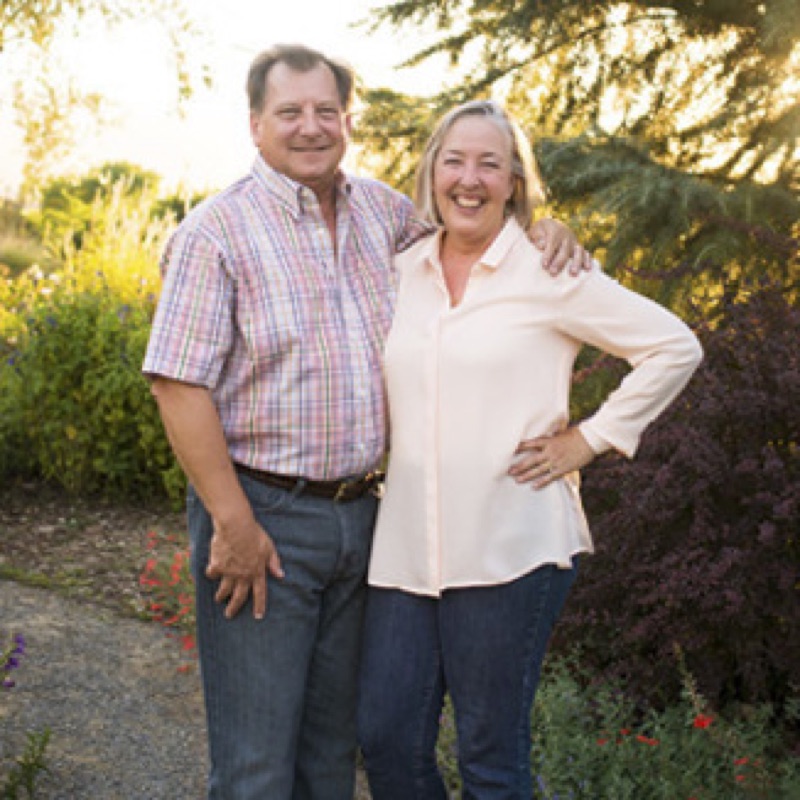
Tracey Skupny
Voices of St. HelenaMatias Ruvalcaba: This is Matias Ruvalcaba. I am pleased to welcome Tracey Skupny, who I am interviewing on behalf of the Saint Helena Historical Society Oral History Program. We are conducting this interview at 2:52 on Wednesday, April 15, 2026 at St. Helena High School. Welcome, Tracey Skupny. Can you begin telling us about your childhood and where you were born?
Tracey Skupny: Yes. Nice to be here. Thanks for thinking of asking me, I guess. Recall from my childhood. Let’s see. I look back and I think I had a really happy childhood. I remember being really happy. I was born in the Midwest, so all my roots come from Midwestern people. I was born in Effingham, Illinois, but moved when I was very little to Fort Madison, Iowa. And then by the time I was four, we moved to Overland Park, Kansas, and that’s where we stayed until I went to college and then got married and moved from there. So really, Kansas is what I call home. And we visited my grandparents every month to a really small town, Overland Park, Kansas, is a big suburb. I like to compare it to St. Helena High because St. Helena in general has about 400 students, would you say, still, 100 per class. My school had 1000 people in my class. And it was a class of three levels, ten, eleven, and twelve, and each class had a 1000 students in it. It was like going to a little junior college. We had two theaters, a giant stadium. For senior day, “The Who” played on our football field in the late 60s, my sister got to go. But I never thought about ever being in a small town, and having my kids go to a small school, and I prefer it. It’s like so much more tangible where I kind of could know the kids’ teachers and be in the classroom and know the friends they were making and all that. Even though I grew up in a fancy suburb, I liked what we had for our kids now better than I think what I had when I was growing up. There wasn’t a lot of our community was very big. So you could get away with a lot because nobody knew who you were. But here everybody knows who you are, which you already know. So I like the small community better.
MR: Are there any more things you can tell us about your high school experience?
TS: Yes, quite a few. We really focused on theater. I studied the sciences, but we had two auditoriums, a big auditorium, and a little auditorium. And so they had a really big drama department. We didn’t have a Patti Coyle, like here, but we had arts and drama offered all the time, all the way through, Music two. And the diversity of students made it really nice because you could have your own small little clique. And I was generally in like the hippie clique. I was pretty much a hippie in high school. And but there were jocks, there were all kinds of groups like every high school has. But I liked the campus. I felt like it was a very sophisticated thing that prepared you for going on in life because again, it was so big and brand new. I tended not to get lost, but a lot of kids did get lost because it was so big and there were so many students. So it had pros and cons that way. I was a cheerleader for about two weeks, and then I didn’t make the team, so I didn’t get to be a cheerleader. That was about as jockey as I got and I remember being on student council. I liked being an officer because we could get out of class and go, you know, pretend like we were doing student council work and stuff. And I also took one of the first computer science classes. Because remember, I’m old, and in seventy-two, they were offering computer science at our high school. And that was pretty cool. It was old punch card stuff. You could make calendars and do very basic programming. But it was very advanced for that era. And I know KU [University of Kansas] that was so close, was offering a computer science major. And that was one of the first in the United States to start offering regular computer programs. So it seems like a long time ago. Those computers were mainframes that took up a whole classroom of their own. That’s how big computers used to be. Does that make me sound old? [Laughing]
MR: Yeah.
TS: Yeah. So I liked high school. I got my license right when I was sixteen. Most everybody did. I got in a lot of trouble with my girlfriend because we like to smoke cigarettes and drive everywhere, and we had a very exciting high school, a few years, but I still got good grades. That was kind of my saving grace. I got good grades, but we had a lot of fun.
MR: What about your interests or hobbies during that time?
TS: Well, I was always into science, wildlife sciences, and the cool thing about our high school is they had a big empty field, and they made it a biology science field. So for the classes we could take. We could go out and do field work. Kind of, there was a creek that ran through it so we could take a lot of samples from the creek and we could identify all the plants on the bluff by the creek. It was a really big piece of property, and they left it wild. And it was a little bit of a grassland because we were in Kansas and a little wooded area, it was where the creek ran. We have lots of animals to collect, some lizards and snakes and fish and stuff like that to identify. So I love that. That was really great for remembering what I love to study. I loved math. So that was why I took the computer science class, my upper math classes and the biology class. What else?
MR: What about your town in Kansas? How was it?
TS: Overland Park? It was a real suburb and it’s outside of Kansas City. Kansas City sits half in Kansas and half in Missouri, the Missouri River cuts it in half. And so we’re a suburb of the Kansas City area on the Kansas side. And It was really built up in the 50s. So when my family moved to Overland Park, we were the last house on our block that was built, the rest were in construction, or there [were] prairie fields after that. Now, our high school was built at the very edge of all the new residential houses. Now, 50 miles south of our high school, it’s all huge developments, shopping centers, houses, apartments, and so all that farmland that was where we played is gone. And so that development was really big and fast. And I don’t think I want to move back there. Everybody, that was in our old neighborhood, kind of grew up out of those little houses and moved out further south where this big development was. So it’s a big suburb. I don’t have anything to compare it to for you, in Saint Helena or Napa, or Yountville. It was kind of like living in Fairfield. That, you know, big populated area that has a lot of high schools. Our high school division or district was called Shawnee Mission. We were at south. There’s a Shawnee Mission north, east, west, northwest, and southwest. So in our whole district, we had like six high schools. It’s a big area, a big population. A lot of weather. You could ask me about tornadoes. We had a lot of tornadoes.
MR: So going back to your family history, what can you tell us about it?
TS: Well, there’s a lot in the questionnaire that I filled out for you. And that, to me, was really a source of pride because on my dad’s side, who’s from that little bitty town in Kansas called Humboldt. His family did a lot of family tree research. And so I have a fifth great grandfather, whose name is John Hay, and in history, John Hay was the Personal secretary to Abraham Lincoln. And they lived in Springfield, Illinois. Remember, I was born in Illinois, so a whole part of that family is from Illinois. And this John Hay and his father were very involved in the government, supporting President Lincoln and then earlier, supporting George Washington. And so we have a family tree that goes back through the Civil War and the Revolutionary War, the American Revolution. And then after that, this same kind of family line dates back into England to the year 1000. And so it’s just crazy that somebody cared and kept track of that without having a computer or “twenty-three and me” or “ancestry.com”. And so we have this family tree that I always like to look at. And that side of the family had old pieces of furniture that we still have in the family that great, great, great grandparents used in their house in Springfield, Illinois. So I don’t know, I just thought it was interesting. My grandfather on that side of the family loved to collect stuff, a lot of antiques and coin collection, a marble collection. And I loved to paw through it when I was little. Going to this place, Humboldt, Kansas, when we were little, we’d go once a month to visit my grandparents. I was in heaven. I was like, yeah. Let me in. I want to go look through all your stuff and he didn’t care if I touched everything. So that was a real good source of pride for me was that side of the family. The other side of my family, my mom’s side, we’re all immigrants. They came over Ellis Island. In the middle 1800s, the late 1800s, and they were probably, not much history on that side, but fleeing poverty, lousy politics, maybe persecution, from Germany, central Europe, where the eastern bloc countries are. They came from there and went over Ellis Island, like so many other people did, and settled in New England, New York City, and New Jersey. And then eventually got transferred to Kansas, and that’s where she met my dad. So that was it. The two families, but not much history on my mom’s side. And I think because of the immigration part where they were fleeing you know, wars, I think, World War One had happened and just a lot of persecution. I think poverty and starvation was a lot of the trouble for why Europeans were getting out of Europe and coming to the states because we were still so new and such a land of opportunity. So, I don’t know much about that side. I think my other side really documented everything.
MR: Yeah. Specifically, what about your grandparents?
TS: What about him?
MR: How did they make a living?
TS: My grandmother [Frances McKenzie Armel] in Humboldt, she wrote for the newspaper. She just wrote articles for the [The Humboldt Union]. And so she always had a small job, but she raised kids, and that was the tradition for her in her age range, and she was born in the early 1900s. Lived to be ninety five. My grandfather [Nathanel Amos Armel], her husband, was born in 1896, and lived to be eighty, and he worked for a plant. He was an administrator at the brick plant in Humboldt, Kansas. They had a brick plant [Monarch, Cement Company] on the river. And I have a Humboldt brick where he worked. He was already retired by the time I was born. My other grandfather, the Lang [Alfred E. Lang], who’s from Germany. He worked for Prudential insurance company [Prudential Financial]. And that’s why he got transferred. My grandmother didn’t work. He started working in [the] New Jersey, New York area, got transferred to Chicago, and then he got transferred to Kansas. So they kind of migrated across and ended up staying in [the] Kansas City area. And living down the street from us when they retired, they moved on to our street, which was kind of neat. I had grandparents that live right down the street and never had them be so close before. But he worked for Prudential Insurance company. That grandmother, his wife, my Gigi [Mary Lang]. She never had a driver’s license. She didn’t know how to fill her car with gas when it was time for her to get a driver [License].
Alondra Calderon: [Astonished laughter]
TS: She had a driver’s license when she was sixty five years old. Pappy [Alfred Lang] had passed away and I was dumbfounded that she did not know how to drive a car. Like, you’re kidding. So she got her license. I’m very proud of that. And she drove to the grocery store and she drove to church. And she lived to be ninety something. So for thirty years, her car only had 3000 miles on it. She didn’t drive much. But I love that she lived down the street and I would go, by then I was a teenager and I would go, you know, spend the night at her house and we’d play cards and she’d buy me Coca-Cola and cashews.
MR: Yeah.
TS: I’d play cards and eat cashews.
MR: So you grew up a lot with your grandparents’ house?
TS: We did, yeah. Mostly because Gram and Pappy, my mom’s side, lived down the street, and Gram and Pop, who lived in Humboldt, that was only an hour and a half drive, and we went every month, once a month, we went to Humboldt to visit them. So I felt close. We have a family reunion for that Humboldt side of the family once every two years, and there’s sixty five of us that get together.
MR: Wow.
TS: I know, it’s kind of cool. A lot of cousins, and now I’m one of the oldest ones, our elders have all passed away. I’m now an elder. Yeah.
MR: Well, what did your younger stuff envision for the future?
TS: Oh man, that’s a tough one. You didn’t ask me that already, did you?
AC: I don’t think so.
TS: I don’t think so. I remember always feeling optimistic. I remember learning about climate change when I was in college. It didn’t seem so urgent. And now, looking back, I think, we knew a lot then and we didn’t do anything. And so we should have been worried, and it wasn’t in our economic interest to be worried about climate change at the time, where now it is. And I just, I don’t know, I was gonna travel the world. It’s gonna be very international. I was going to be bilingual. I was going to be an airline stewardess and travel all over the world and I probably wasn’t going to settle down and be married. I probably wasn’t going to have kids, it [was] just going to be me. None of that happened. [Laughing]
TS: I’m not bilingual, but I love to speak French. And so French is my wannabe language if I could only live there.I know a lot of French, but it’s hard to speak. And I have traveled a lot, but I fell in love with this guy I met in high school. We didn’t date till college, but that’s my husband, John. We met when we were sixteen or seventeen years old. So it’s interesting looking back, that you don’t know what you’re experiencing now, that may be with you in the future. You like somebody you know from school or whatever, and we always just hung out in high school together, and it wasn’t till college that we kinda ran into each other again. I’m like “Hey, I’m not doing anything, you’d do anything. No?” So we went out for a beer, and that was it. Saw each other every day since. Literally, we’ll be married fifty years this summer [Next year in 2027].
AC: Oh, Congrats!
TS: It’ll be our 50th anniversary. Yep.
MR: So how did you go about choosing your college?
TS: Oh my gosh, my mom and dad and I loaded up in the car. And we drove across Kansas and we saw KU. I already knew what KU looked like because my sister went there. We went to a Catholic college in St. Mary’s, Kansas, and we toured that little bitty campus, little private school. I knew I didn’t want to go there. It was in a tiny town in nowhere. Like, this is the worst. I don’t want to go here and we went all the way out to Colorado. I looked at Boulder and Greeley and Fort Collins, Colorado State University. And I ended up getting in there. So I went one year at Colorado State University. Big talker over here. Came back my next year because I missed all my friends. [Laughing]
TS: So it’s like, I thought that’s what I wanted, but I had a best girlfriend, and she had gone to Wichita State , and she and I were both coming back to go to KU, and we wanted to be roommates.
MR: Did you have any specific careers in mind during that time?
TS: No, remember I was going to be an airline stewardess. But I thought, well, I just, I want to do things I like, and I just chose the sciences because I liked it. And it had a lot of math classes that came with it. So I was like, okay, I can take math, I can study my life science stuff. Plant biology and everything. But all along the way, I kept taking my French classes. So I started French class in seventh grade and took them all the way through graduating college. So I had ten years of French language and culture in me. I just took courses I liked. I didn’t really have a career [in] mind and it didn’t make my dad very happy because by the time I was graduating, he’s saying, “Tracey, get your resume out there.” And by this time, I was already dating John, my husband. And he was an art student. He did fine arts and painting and stuff. He was in the art department. We were very opposite headspaces because I was in the sciences and he was in art. We’re very different people. And so my dad said, “you start getting your resume, where are you going to make applications?” And, like, [I] don’t really, don’t really want to begin it, work in a laboratory. I don’t want to be in a building. I wanted to do field science, I could do that. But I was very much more interested in dating John Skupny. Like, I don’t know. John’s still here. So anyway, I graduated from college with my dad giving me pressure to hurry up and apply for jobs. And I had saved enough money to send myself to Europe for college graduation. So I did. I got to practice my French, didn’t do it well, but I got to be in France, and try and use my language. And John and I… Announcement by Mr. Fetters: Good afternoon Saint Helena high school. Teachers, if you have not done so already. Before you take off today, could you please take your access attendance once again? If you saw students today, please take your access attendance and submit it to Nancy and me. Thank you have a nice day.
TS: John and I had broken up just before I graduated from college. He had already graduated a semester before me. He was traveling around with a good friend of ours. And, I leave for Europe, without my boyfriend, sad that I lost my boyfriend. And I’m in Europe, and I think to myself, maybe I’ll meet, you know, like the man of my dreams, traveling in Europe. I’ll come home married or something like that. And I came home married, to John. So he started sending me telegrams saying, “Hey, I can meet you in Luxembourg if you want,” and I wasn’t getting the telegrams. I was out traveling and they were going to my uncle’s house in Switzerland when I wasn’t there. So I get back to these three telegrams. One says, “Hey, I can meet you in Luxembourg if you want.” The next one says, “Hey, I can meet you in Luxembourg if you want.” The third one says, “Why aren’t you answering my telegrams?” [Laughing]
TS: I hadn’t gotten them. So, he knew me well. That I’m kind of an all or nothing person. And I thought he wouldn’t be following me to Europe if it wasn’t very, very, very important. And so he asked me to marry him the day he arrived. He said, “Will you please marry me?” [Her reply] “Okay”. [Laughing]
TS: So I said “On one condition that we get married there and go home already married.” And so we did. We got married by a Justice of the Peace and called our parents. They were very excited. They both liked us. They wanted us to stay together. So that was why I didn’t get a job in the sciences. John and I knew we wanted to open a restaurant. We loved food and service. We worked in restaurants. We thought that was the dream we shared together, that we wanted to own a restaurant. My dad wanted to kill me because of all that studying I did in the sciences that I wasn’t going to use. And so we went home. We started working in restaurants in Kansas City, and the more we worked in them, the less we wanted the food part. And the more we really liked the wine part. Because the restaurants were selling wine. I know you already know what I do. The restaurants were all selling wine, and we were learning how to taste wine, how to serve it to table side, and we both kind of elevated [ourselves] by training to become wine directors in restaurants. And this is in the late seventies, again, kind of like way before the big wave of popularity for wine stewards and stuff like that. So we decided that we wanted to move from Kansas City. It was kind of not going anywhere for that direction of wine studies. And we could move to California and be near wine country, or we could move to Bordeaux. I could speak French. And we decided that we couldn’t afford to go to Bordeaux, but we could afford to move to California. So we sold everything, got a U-Haul, and with our dog in the front seat we drove across the state and landed in San Francisco for three years. And then Reed was born there, our older son. And when he was a year old, we moved to where we live in St. Helena, the same place, same street. He’s forty-three years old, that was forty-two years ago. So, we’ve been on Vineyard Avenue for forty-two years. In Saint Helena, the smallest town I ever knew, but it was great, and that was how we ended up being in the wine business, and from all that beginning in the Midwest.
MR: How was arriving at San Francisco for the first time like?
TS: It was crazy. So it was in 1980, and the hippie days were long gone, but it still had all that feeling of it being a very international city, incredibly liberal. It was really ethnic. Growing up in Overland Park. It was as white as could be. There was barely any person of color, of ethnic background in my upbringing. And so San Francisco was like, wow, it was in vivid color. It was so exciting to live there. And we had a little Vespa. And we’ve, you know, tooled around on our little Vespa, had our little helmets on and we were like real city people. And we liked it. It was politically inspiring because San Francisco cares about stuff. You know, the national smoking day started in the early eighties in San Francisco. They were one of the first cities to not have smoking in restaurants, outside restaurant doors, and all that progressive attitude was really feeding us because I was from a very conservative state and community. So we liked it. It was very full of arts too. Remember, John’s got his degree in printmaking and painting, and so Golden Gate Park was a blast, all the museums were very stimulating. So we loved it. It did get to be too crowded to have a baby. And so, the birth group we were in, we all had these little newborns, and some of the parents were already putting their kids’ names on preschool waitlists. And I’m like, “But my baby’s not even six months old yet.” And that kind of turned me off. I thought, I don’t want to be part of that crowd. That’s like too city. I wasn’t that urban, really. I was suburban. I wasn’t urban. I was a suburban kid. Now I’m a small town kid. And so we started looking and we knew we wanted to be in wine country. It didn’t, matter where it could have been Healdsburg or Sonoma, it could have been Monterey, any place that had wine growing areas where we could work for a winery, and we didn’t know where in a winery. It could have been in production or sales and admin and stuff. So John happened to get a job in St. Helena. That was one driving factor that made us land here, is that he got a job. And that’s what brought us here. And that was at Caymus Vineyards in Rutherford. So he worked there for a few years, and I worked for a winery in town called Spottswoode. And that was it. And then one day we decide, maybe we’ll make our own wine. And so we make our own wine.
MR: So what was your first impression on Saint Helena upon arriving?
TS: I loved it. It was so western looking. One downtown block. That was kind of cool. And we had visited many times anyway. So, coming from San Francisco up to wine country and being a tourist. We had driven around St. Helena already looking. There was one time we drove by the elementary school, and we kind of said, “Wow, what if we ever have kids and they go here?” Didn’t know it was going to happen? But they did. That kind of stuff kept happening where it felt really comfortable here. It felt like home in that sense that you don’t know why you feel that way, but it’s very comforting. John, I always felt like maybe this could be a hometown for us. It was very welcoming and I liked it. But you remember, there was only one light at the time. Since then, we have all the street lights and traffic lights. I mean, but when we moved here, there was one traffic light. It was at Adams and Main Street. And no stop signs. On Main Street you just free wheeled it all the way.
MR: Can you tell me more about your position at Spottswoode winery?
TS: Oh, yeah. That was a family that bought that Spottswoode estate. Do you know where it is on Hudson and Madrona? [Door Creaking] [Mr.B walks in]
TS: It’s a stone building that’s a wine barrel storage room, and a little Victorian house that looks like our office, and it’s at Hudson and Madrona? Jerzy was finally in school in first grade. And I could work between nine and three o’clock. So I went to Spottswoode, knocked on their door, and they said, absolutely. I didn’t know anybody there, but they happened to be in need. It was just serendipitous. And I started out just doing clerk work, entering orders, [and] shipping wine. I got to give tours to tasters. People who’d come visit, and they kind of trained me to start pouring wine and educating them about the Spottswoode estate and the history of their winemaking and the family and stuff. Then I switched gears because I was there for eleven years, and I went over to the wholesale side, and I helped sell wine to restaurants and retail stores, and to distributors across the United States. And that was it. I finally retired from Spottswoode to go into full business with our wine company. But the family at Spottswoode was really cooperative. They were like, “Tracey, if you’re selling our wine, take your wine with it. And sell both our wines together.” And that’s unheard of. That was really supportive and very gracious on their part to let me promote my own wines while I was also promoting their wines. So it was high trust and good friends there. I think, but I liked it. It was so close to our house because Hudson and Madrona is only, like, three big blocks from where we live. So it’s nice to work in the neighborhood. The kids would come home from school via Spottswoode and come get me at work, and I got off at 3:00, and we all went home.
MR: Yeah. During this time, I heard that people like Dan Duckhorn and Dick Ward gave you guys some advice.
TS: Yes.
MR: How crucial was their mentorship?
TS: Well, that was really important because in the reputation of Napa Valley vintners, it’s always been supportive, at least from our viewpoint, where if you needed a piece of equipment, call the winery down the road and say, “Do you have a tractor I can borrow? Do you have a forklift I can borrow?” And there’s that support [that] is always there, really open with information about how to make wine. What’s happening in the vineyard? So, the agriculture nature, I think, of Napa Valley requires that we all share information and support each other. When we first wanted to buy grapes. We didn’t have a reputation. We had never made wine before. We were always on the sales side, not the production side. And so John went out to Dan Duckhorn. And said, “Hey, I’m looking for Cabernet Franc,” and he sold us some grapes. And it was hard. We had no response from a couple other people that said, “No, we don’t have grapes or we don’t know what kind of wine you’ll make with our grapes,” that kind of thing. And one of John’s mentors was Dick Ward from Saintsbury Winery. And so that kind of support and guidance from your mentors is really key to feeling like you’re making good decisions and you’re going forward. There is competition. Can’t deny that. We all want to be on the shelf and we want all our wine to sell. But there’s this camaraderie that’s very supportive and that feels good. I think that’s because of the Napa Valley Vintners Association. It’s a trade organization that kind of lifts all boats. It supports all the wineries that are members and shares all that information with each other. And you can’t help it, if you’re out on the road selling wine, and you’re with ten other wineries, you’re working together, you’re playing together, you’re friends, your kids probably go to school together. That’s the small community. Unlike Overland Park, Kansas that wasn’t so small.
MR: Yeah. So what pushed you to focus on Cabernet Franc?
TS: Oh my God. Well, let’s see. He’s the only one interviewing today? Do you have your set of questions?
AC: [Shakes head] [No]
MR: No, it’s just one thing. [Laughing]
TS: Well, that’s an interesting story because, oh, actually! I forgot you were here [Looks at Mr. B]. We had all the support in the St. Helena area, and everybody’s making Cabernet Sauvignon. And they’re all doing a great job. They’ve got a vineyard, they’ve got a name. They probably had deep pockets so they had money to support it. And John and I didn’t have any of that. We didn’t have any money. We just had a desire, had a concept. And he sold his car for our first ton of grapes. And we had one car for a long, long time. And Cabernet Franc was the unsung hero. It was very affordable at the time. Typically, it’s used as a blending grape to enhance or balance out other dark reds like Cabernet. And so we had two experiences where we thought, okay, if we’re going to make wine, and we don’t want to compete with our friends because they’re already doing a great job. We wanted to be red, we wanted to be very palate friendly, and I was working in Spottswoode, and going home to … I can turn this way. [Turns to Mr. B]
Evan Blasingame: [Waves to us]
TS: [Turns back to us] Going to work to sample out of the barrel with customers. And I got home and John and I ate dinner, we’d always say, “So what did you do at work all day?” And I said, “Well, I tasted the prettiest Cab Franc out of barrel. Why the heck is it getting blended away?” And so we talked about the qualities of Cabernet Franc and how attractive it is and easy on the palate. It’s not, I know you don’t drink wine, but it’s not astringent and grippy and tannic, like red wine can be very tannic. And that kind of pulls at your cheeks, like you don’t have any saliva anymore. The other thing that happened is we have dinner on the table. Alex isn’t born yet. We have dinner on the table. The boys are little, and I’ve made meatloaf. And I say, “Hey, babe, go to the garage and get a bottle of red wine for dinner.” And the boys are having to like, sit on their hands, not eat yet till dad sits down. And they’re getting antsy, and John comes back in from the garage empty handed, and he goes, I don’t know. The only wines I found were Cabernet that isn’t ready to drink. It should age a little bit longer or wines that are who’s vintage is the boy’s birth years. We can’t drink those. It’s for the boys. And I said, “I know there’s wine out there. My meatloaf is getting cold. Go get a bottle of wine.” I was getting kind of frustrated. And so he comes back in, he puts a bottle of wine down on the table and he goes, “I don’t know if this is going to be great with meatloaf, and it might be a little bit too expensive to drink on a Tuesday night, but we’ll open.” And I said, “I don’t care what it is. Pull that cork, boys start eating,” and they just, like, chow down on their plate. And we laughed about what that little irritation was. Where we couldn’t easily find a bottle of wine to grab for dinner. [Phone Ringing] Sorry. And it had to do with not having this everyday, easy to drink red wine that used to be so cultural. The Italians always had, Spanish people always had an easy drinking bottle of wine to have with dinner. It wasn’t special. You didn’t have to talk about it. It was just food on your dinner table. And so we were realizing all of St. Helena and Napa Valley in particular, we’re integrating wine as an everyday item for dinner, not that it was a specialty. And that’s especially the families in the winemaking business, that they were drinking wine every day, every evening with dinner, like many Europeans do. And international people. So, we thought that the kind of wine we want to make is one that didn’t hurt your pocketbook, it wasn’t going to be too expensive, it had to be super easy to drink, but it still had to be complex and intriguing. So it’s like this interesting mix, and that’s how we got back to Cabernet Franc, from that barrel tasting at Spottswoode one day, where it’s like, wow, this is really great right now. Can’t we just put a cork in it and slap a label on it and say it’s done. So that was how we got started. And we named it after the boys. Their middle names are Lang and Reed. John Reed Skupny and Jerzy Lang Skupny. Lang is my mother’s maiden name, and Reed is John’s grandmother’s maiden name. And so, that was how we made our wine label and decided to make Cabernet Franc. And just slowly grew over the years, and we kind of love it. I didn’t quit my job. I kept my job for quite a while. But then I finally quit my job. Now I got my new job. So that was how we figured out Cabernet Franc, and it wasn’t popular at the time. It was a hard sell to make in those early years. This is our 30th anniversary year. Our first market was in 1996. We made our first wine and came out in the market and made our company. So we’re celebrating thirty years and I keep saying, “And we’re still here! We haven’t gone under yet.”
MR: Did you ever feel nervous focusing so hardly on Cabernet Franc?
TS: Yeah, it was hard because we had to educate people about it, it was to us a well-known grape and to winemakers. It’s a well known grape, but to the general public that we’re trying to get to come visit us and buy our wine. There were many levels of education that came to our front door. One would say, “Is it a grape?” And like we go, “Yes, it’s a grape. We’re in wine country. It’s a grape.” And others were very advanced and knew exactly where in the world it grew, where it was popular. But it was hard to find shelf space. And that means when you’re in a wine shop, and sometimes they have the California selection, sometimes they have a Pinot Noir collection. It was hard to know where they were going to put the Cabernet Franc because it got lost in the other varieties, Cabernet, Pinot Noir in particular, Syrah, Zinfandel had its own section. But Cabernet Franc, there was hardly anyone making it alone. And that was our only wine. For twenty years, we only made two kinds of Cabernet Franc. So it was hard to get our bottle in front of people, and without having to tell our story over and over. So getting salespeople educated behind it for distribution, we were in thirty-five states. And we shipped to New York and Chicago and Texas and places like that, but John traveled a lot. He was on the road probably two weeks a month for quite a few years. That was a lot of travel. So we promoted it and had to get out and educate people about Cabernet Franc. Finally, people are looking for Cabernet France. Whoa! Thirty years later, we were on to something! So. Yeah, it was hard because we had to educate a lot. And we didn’t have a front door for a long time. I didn’t have a tasting room permit. We had a website presence, but our old website was real flat. Our original order form, you had to print, go to the website, print the order form, fill it out, scan it, and send it back to me. That’s a long haul for a customer to have to do all that, but we advanced as websites advanced, you know, so did we. That was good. But we finally got a tasting room permit. Only in 2020. For twenty-five years, we didn’t have a front door. And so we had a grand opening at the place in spring and oh, there’s a cute little Victorian house at Spring and Oak. We had a grand opening planned for March of 2020. What do you remember about March of 2020?
MR: With COVID?
TS: Yes. [Laughing]
TS: We did not have a grand opening for a couple years. So that was a funny start to having a tasting room for the first time, is that nobody could come. But they’re coming back now.
MR: How impactful was your job as a wine steward or at Spottswoode winery in your success?
TS: Incredible impact because of credibility. So when you’re telling people your story about why you are in this business or what you know about wine, it sounds good to hear that we actually worked selling wine to customers in restaurants. That we belong to wine clubs and practice tasting, learning how to taste wine, sometimes in blind tastings, where you have all your bottles covered up, and you have to guess what wine it is. But then the real influence came with having a winery like Spottswoode on my resume, because they’re way up [Hand motion going up] here in respect and quality. And so if I’m way down here going, “But I work at Spottswoode” they’re like, “Oh, we’ll pay attention a little bit,” you know, so that helped that Spottswoode let me share their vendors. So if we shared a distributor, they would say, “Go do your sales too,” they’d let me ride on their shirt tails with my wines. And that really opened a lot of doors. It’s like Dan Duckhorn helping John find grapes for the first time. So that camaraderie comes back again of supporting each other and everything. So it helped, grab people’s attention, to recognize that we had some credentials, for being in the business, working at it for so many years, because it sounds like a lot of years, if you think about it, from the time you’re twenty. That’s more than fifty years.
MR: So, can you tell us about the 1993 Stanton Vineyard grapes?
TS: Yes, why? You’re kidding. [Laughing]
MR: Because it’s interesting …
TS: That’s crazy. Well, he was another one who was really supportive, Doug Stanton. And I knew his sister, Leslie, our old librarian from the St. Helena Public Schools Library. Our kids went to school together, not Doug Stans, but Leslie and her kids went to school with our kids. And so he had a really pretty Cabernet Franc vineyard that was in Oakville. Just south of the cooperative winery that’s there. I forget what it’s called. [Napa Wine Company] but just south of the intersection in Oakville. And it was a really beautiful cab franc, and we were trying to get more specified vineyards, the vineyards that had a higher quality to them. And he was one of the first to sell to us. He had a place in St. Helena, but I don’t remember ever buying grapes from his St. Helena vineyard. But Doug was great. He was a very friendly guy. And it’s always handshake stuff. I don’t think we ever had a contract with Doug. I think he’s like, “You want a couple tons?” Okay, we’d shake on it. Those days are gone, but that was early.
MR: So how drastic was the change from selling wine to producing your own wine?
TS: That is a big one because John doesn’t have any formal education in making wine. But we like to compare it to being in a restaurant. Start in a restaurant and you’re a bus boy. And you can graduate to become a waiter. Then you could graduate to maybe becoming an assistant manager, and then a manager, and maybe someday you own the restaurant. And so we’ve always believed in, first of all, making the kids work at restaurants because it’s such good training, but that you can learn from the ground up. And by pitching in at harvest and standing on the bottling line when it’s time to bottle wine, even making strategic planning meetings where we would be on the front side selling, but we’d have to work with the production team to talk about quantities. You start to kind of just merge into both departments. And he did take online courses. He assisted a lot of winemaking activities, but when the time came for him to make his own wine, he relied on that camaraderie again. And so there were a couple key winemakers that would love to talk to him about when you get your lab reports. Here’s what you look for when you’re testing sulfur, looking for alcohol levels, wondering what yeast to choose for fermentation. So he just learned it. As if he’d been working in wineries in the production side his whole life. But always with the help of friends. The thing that has John head and shoulders ahead of many people is that he’s got a really trained palate. So when he’s tasting grapes or wine in a barrel or wine that’s fermenting, he already is formulating what its future is going to be based on the flavors. It’s kind of how it works. You taste it and you think, what do I gotta do next? And we do custom crush, so we don’t own a winery, and we don’t own any vineyards, we contract all our grapes. And Laird Family Estate is where we’ve been the longest. And they said from the beginning, “When you get here, act like this is your winery. Pretend like this is yours.” And so he goes in and leaves work orders for their team, but he tastes out of the barrels every day. He was there at crush with the grapes, you know, on the crush pad. And then he’s tasting wine while it’s fermenting and taking lab samples and all that kind of stuff. So he just learned from the ground up. And it was a hard transition for him and I’m just still in sales. I haven’t transitioned anywhere, just doing more of all that. But it was hard, and we had to have a lot of advice and support, and he had to find courage, you know, to realize he was making a lot of great decisions.
MR: So, how important was it to have your husband by your side pretty much your whole life?
TS: It’s interesting. But I have questions about it. [Laughing]
TS: And I joke about it. We think, where would we be if, you know, always these questions at our age looking back? You’re at the beginning looking forward; I’m at the end of it looking back, right? And It’s funny because we’ve always been best friends and we were friends first. We were friends for quite a few years before we started dating. So we had this foundation that was pretty safe, and we knew each other pretty well, and we had shared all the same friends. There wasn’t anything that was a clash. Now at this date, the struggle is finding time to be alone, because we’re together all the time, and there’s a shift where building up, it’s like, yeah, let’s do this, and then a kind of a time where like, okay, I’m at the crest and now I kind of like, I’d like to do my own thing. So we find time to have our own interests. And I dive deep into yoga. I go to yoga class several times a week. I love to hike. I love to get away with one girlfriend. We like to go away like twice a year. We’ll go away for a big overnight, like out to Bodega Bay or something. And so at that time, you have to really make sure that you take care of yourself and that you take care of yourself as a couple, and then you take care of business, and make sure the business is successful. And I think we’ve been doing a good job at it. But it’s intense. It’s a lot but we’re still doing it. Fifty years later, it’s just fine.
MR: Looking back on Napa, what do you think has changed?
TS: Well, what I miss about the things I loved about Napa, early on was at the kind of the original populations that were here, meaning the Napa used to be kind of a cowboy town, and I know when Reed was in high school, he’s like, “Mom, I am never living in Napa.” I’m like, “Reed, what’s wrong with Napa? Its got the fairgrounds, it’s got the movie theater? What’s going on?” And now he lives in Napa, and he loves it, and he goes, “I would never live in St. Helena.” Like, okay, the grass is always greener I know it. But Napa’s really come up. The population has shifted hugely. It’s got a Costco now, it has two Targets. It’s like, wow. And so that’s a really big difference. And it’s become more of a second home community, a valley even more, and that’s worrisome to me. We’ve already had our Catholic school closed because of not being able to support what the Catholic church needed to keep the school going. I blame it on second home people who aren’t bringing their families here. They’re coming to vacation, and they’re keeping a house unavailable for families to live in or rent or buy. And so the complexion of St. Helena in particular is changing to being less residential, in fact, that’s what we liked about it compared to all of Napa Valley. St. Helena was where families lived. Calistoga was where tourists went, right? It was like that basic difference. And so even on our street, Vineyard Avenue. It ends in a giant cul-de-sac, and we have two homes that are beautiful, but no one ever is there, but a couple weeks a year. Like, I’d love to have a neighbor or someone who contributes to the community. I think that’s what I like. I’d like to see more young families, be able to live here. Reed and his family can’t afford to live here. They live in Napa for that reason too. So that’s a lament for him as he wishes he could afford to live where he grew up. And, you know, it’s just, that’s the hard part for anybody who wants to stay to also own. And that’s been the big shift is pricing of houses and availability for homes in all of Napa Valley. But St. Helena’s key for wanting a place to live. So those are the big changes. The traffic is one big one. You know the days of getting to Napa in twenty five minutes are gone.
MR: Ya
TS: We always have to allow a little bit more. And so traffic slows you down, and the vintners, remember I mentioned the Napa Valley Vintners Association, they did a study, one year on the traffic, and what could the vintners do to help ease the traffic load, and what they discovered after analyzing everybody who drove up and down [Highway] 29, it was mostly vintners that were contributing to the traffic by winery workers, vineyard workers, salespeople, production people. They were all using the highway to get to and from their jobs. In the high seasons, yes, we had tourists using the highway too, but we had our own problem of too much traffic. That was pretty profound to learn.
MR: Can you tell me any more about your personal hobbies, such as yoga and breath work, what inspired it?
TS: Well, health, for one thing. I was an aerobic teacher locally for about eight years, you know, over at the Presbyterian Church, and it was in the Jane Fonda days where you wore a headband and a big wide belt and had matching leotards and tights and bobby socks and stuff. So I taught aerobics and then I went to work at Spottswoode. I was like, oh, I’m sitting at a desk all day. And I knew that there was this intense yoga class three nights a week on El Bonita. And their kids went to St. Helena High. So I’d go to [Iyengar Yoga Napa Valley] to do yoga, and it became not really spiritual, but it was really very calming, and it was strenuous at the same time, kind of like doing Tai Chi, where it’s all that slow movement and you hold it. And so I found that really something that was just for me. And that was that thing about where I could get a shift in my experiences, away from being at my desk all the time and thinking about wine all the time. Yoga let me escape. And that was kind of what it was. Plus, I had a girlfriend from Spottswoode. Her kids went here too, and we walked. I had four dogs. I didn’t even tell you about the dog thing. I had four dogs, and she had one dog, and we’d walk them three mornings a week. We drop the kids off at zero period here, meet at the top of Spring Street, and then walk all of Sulfur Springs to the end and back. But this other hobby that took us away from work was dog shows. We used to show dogs. And that was our kids “4H.” They weren’t in sports when they were young, not too many sports, and so we did dog shows, and I took dogs around the ring and showed dogs. We bred some dogs at home and they’re unusual dogs. I’ll tell you if you don’t think to ask. I can show you pictures sometimes too. They’re called Salukis and they’re tall, skinny running dogs that are one of the primal breeds, so they’re older than Greyhounds and Afghans. And they were used by the Bedouins in the Arabic countries, mostly Iran. They were Persian in origin. And you’d hunt with three Salukis and the falcon that was trained would circle over the antelope. And when the falcons start to circle, they make sure the Salukis watched the falcon and they’d release the Salukis and the Salukis would run into the herd and hunt. And they’re the fastest running dog, but they can’t race because they won’t run in a straight line. They zigzag. [Laughing]
TS: So that’s what else we did. I can’t believe I left that out. We know every fairground in California. Every other weekend, we were loading the kids up and going to the dog show.
MR: Well, I saw online that you have a YouTube channel called Sip and Savor.
TS: Oh, yeah. Oh, you did some research.
MR: Yeah.
TS: Oh. So that we did during COVID. That was all produced during COVID, and we sent Megan, Megan was working for us, Reed’s wife. We sent her home, said, “Don’t, you know, don’t come in, no business here.” So she called me one day and she goes, “I cannot sit home and do nothing. Can Reed and I start making videos of cooking and pairing it with Lang and Reed wines?” And then hoping people would go online and buy. And so they made twenty two Sip and Savors. And it was a play on words because “stay in place” was the acronym for staying home during COVID. Sit in place, stay in place. And she used it as sip, like sipping wine and savoring food. So that was a really big deal. They’re all on our website. No dogs on the website.
MR: What is the legacy you want to leave behind?
TS: Well, it’s funny because Reed has two kids. His son’s name is Hawk, and he gave Reed his middle name. So he’s Hawk Reed Skupny. Jerzy, our other son, has a boy named Asa and he gave Lang to Asa as his middle name. So they gave their boys their middle names Lang and Reed. Hawk says to Asa, not that long ago, “Asa, you realize that when Mimi and Pa die,” that’s how he’s put it, he said, “we can take over the company because my name is Reed, and your name is Lang.” And so that’s kind of what I wish for, is that, you know, maybe the kids want to do it. Reeds a winemaker. Megan’s an excellent salesperson for another winery. And that would be great. If we left that to the kids, that’d make me happy. And the kids are already thinking about it. I mean, the grandkids, they’re all, like, looking like… [Laughing]
TS: When can we start?
MR: Yeah. If you had to give advice to somebody that’s trying to enter the wine industry, what would you say?
TS: I would say [it] depends on which side you’re attracted to the production or the sales. Start anywhere. Start low and get in there. Like I already talked about the busboy concept at a restaurant. Like work in a wine cellar. For men and women, and the industry shifting, for more equal parts of women being on the production side. It wasn’t that fair, that balance so long ago. I think the first famous winemaker that was a woman finally came around in the 90s. It was that delayed. It’s been a male dominated industry, but not anymore. And it’s such a valuable experience. You know if you like people. You know, if you like to sell, You know, if you like doing spreadsheets and figuring out cost of goods, or you know, if you like getting your hands dirty, and actually making wine. Or harvesting or working in the vineyard, but production’s fun. But it’s a real manual thing. So I say start anywhere and just test it. And make wine here when you’re a senior. Everybody’s done that. I think Reed was the first class that made wine in Vit class here at St. Helena High.
AC: I think that’s all the time we have.
MR: Yeah. Is there anything else you would like to say? Before it ends.
TS: Oh my gosh. Did it end? Closing statement. Oh, well, for me, regardless of my work and in our life path, but you heard how many times I said family. And community. I think that works for anybody anywhere. And St. Helena just had the right formula for us to stay. We had all kinds of other places we wanted to live. But everything just started clicking. And we didn’t know when we were in it, that this was where we were going to stay. So it’s that wisdom of looking back and going, oh, yeah. So just trust and stick with your family if you can. [Laughing]
TS: Or build your family, but that’s really key no matter what business we ended up being in.
AC: All right, thank you for your time.
TS: You’re welcome.
MR: Thank you.
TS: I can’t believe I just talked for an hour.
MR: Yeah. Felt like 20 minutes.
TS: It did go fast. So when you started counting the clock, I’m like, [fast talking noises?] those were great questions. So what else did you see on the website?