
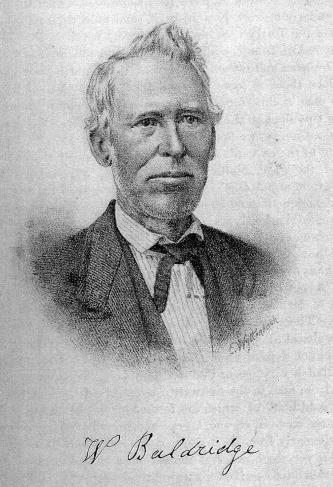
This worthy pioneer was born near Newport, Cocke County, Eastern Tennessee, December 2, 1811, and is the son of James and Mary Thrash Baldridge. His father was of the Scotch-Irish descent. He remained at his birthplace until 1819, when he started West with his father’s family, and arrived in Missouri January 2, 1820, settling in Saline County.
A millwright at seventeen
He followed that business in various places until 1843. In 1830 telling wonderful stories about California. This set Mr. Baldridge to thinking that he would like to pay the country a visit.
At the close of the Florida War, Colonel J. B. Chiles returned home. In the course of a conversation with him, Mr. Baldridge told him what he had heard about California, and proposed that they pay the country a visit. To this the Colonel readily assented, and all arrangements were made for starting out on the trip in 1841. Mr. Baldridge was detained, however, on account of a mill which he had on hand, and was under contract to complete. In 1842 Colonel Chiles returned to Missouri, and gave a good account of his trip to California.
Wagon trains bound for California
In the spring of 1843 a party was made up, consisting of Colonel J. B.
Chiles, William Baldridge, Bartlett Vines, son-in-law of George C. Yount, Mrs. Vines and their two children, Miss Elizabeth Yount, who subsequently married J. C. Davis, John Conn, of Conn Valley and many others. The party left Westport, Missouri, May 30, 1843, with a full equipment for the long and tedious trip over new and undiscovered routes and mountain passes.
They passed up the Platte by old Fort Laramie, on the north fork of that river; thence to Fort Bridger; thence to Fort Hall. Here the party divided, Chiles and some of the mengoing on ahead on horseback, by way of Fort Boise, Idaho, to the head of Pitt River, and thence down the Sacramento to Sutter’s Fort. The object of dividing the party was, that those who remained with the teams might have provisions enough to last them through. The horseback party secured their own provisions as they went along.
At Fort Laramie the party had secured the services of that noted old trapper and hunter Joseph Walker, to pilot them through the mountains, paying him the sum of $300. From Fort Hall the party with the teams, of which Mr. Baldridge was one, proceeded to the Humboldt River and followed that stream to the sink; thence south by way of Carson, Walker, and Owens Lakes, on the east side of the Sierra Nevada Mountains.
Over Walker’s Pass
At Owens Lake they left their wagons, not being able to proceed further with them. They had with them a full set of sawmill irons, including three sash saws, and these were cached there. They then packed their goods on mules and rode their horses, and proceeded on their way. They crossed the mountains, arriving at the summit December 3, 1843. They pushed on into the valley, and then started for Sutter’s Fort.
Walker kept bearing westward, and the first they knew they were very close to Monterey Mr. Baldridge and Atkinson went to that place to purchase passports, and it took them three days to get them, owing to the indolence and indifference of the Mexican officials. At Gilroy they met with James M. Hudspeth and Alexander Copeland, who were at work at that place, and they provided them with fresh horses and escorted them as far as the Pueblo de San Jose. Chas. Weaver then took them to Juan (John) Livermore’s place, and thence they proceeded across the San Joaquin River, near where Stockton now stands, and thence to Sutter’s Fort, where they met the most of their party, and also Colonel Chiles, who had returned from Walkers Pass. Just at this time General Sutter was about to dispatch the schooner ” Sacramento,” a craft which had been included in his famous purchase of the Russian effects at Fort Ross in 1841, to Napa Embarcadero to get lime from Nicolas Higuerra.
Colonel Chiles, Mr. Baldridge, Miss Yount, and the Vines family were given passage upon the vessel.
To Napa County in 1845
Mr. Baldridge worked at his trade of millwright for the first year or two after his arrival here. In 1845 Colonel Chiles and he made preparations to set up a mill in Santa Clara County, getting out all the timbers and shafting at the Yount Saw Mill, but the Micheltorena Revolution broke out at that time, and the project had to be abandoned.
In 1845 Colonel Chiles got his grant from the Mexican Government for the Catacula Rancho, and Mr.
Baldridge being a partner in it, they went upon it and began operations, taking a band of cattle into the valley and building a house there.
1846: troubles with the Mexicans began to arise Neighbors lived far apart, and communication between them was rare, especially in such out of the way places as Chiles Valley.
The Bear Flag Revolt of 1846
In June, Mr. Baldridge and Mr. Thomas Wesley Bradley, took a mule and went east of Berryessa Valley, to get some grindstones which he had previously cut out. They continued on their journey, when they suddenly heard the tramp of horses’ feet, and someone shout out, ” Hold up; don’t come here.”
They recognized the voice of Captain John Grigsby, and immediately went to him, making themselves known. He was accompanied by William Elliott, and they had been to Sutter’s Fort to have a consultation with General Fremont, and were then passing back into Napa Valley by this little- frequented route, and in the night, so as to avoid being seen by the Mexicans and thus arousing their suspicions. Mr. Baldridge proceeded home, and, on the day following the capture of Sonoma, he and Colonel Chiles started for Sutter’s Fort, being anxious to join Fremont’s force and engage in the active campaign.
The march on Sonoma
That night they stopped at William Gordon’s on Cache Creek, and during the night a courier came by on his way to Fremont’s camp, stating that a large force of Mexicans were marching toward Sonoma for the purpose of recapturing it.
A Fourth of July in Sonoma
Mr. Baldridge and Colonel Chiles set out at once to go to the relief of the American party, and arrived at Sonoma on the 16th. He remained at the town of Sonoma until Fremont started to Sutters Fort to begin the active campaign. The 4th of July was celebrated at Sonoma, and the Declaration of Independence was read by Lieutenant Woodworth, of the United States Navy, from a book belonging to Mr. Baldridge, which he had brought across the plains, and which he still has in his possession as a relic of those by-gone days.
The volunteers organize
Mr. Baldridge was chosen chairman of the meeting which was held for this purpose, and John Bidwell was secretary. The force was divided into three companies, and the captains were voted for viva voce, resulting in the election of John Grigsby—who remained in charge of Sonoma with his company—and John Ford and Granville P. Swift, who took their companies upon the campaign with Fremont. Mr. Baldridge was elected orderly sergeant of Captain Swift’s company at this time. On the 6th the whole force, including Fremont’s men and the volunteers, took up the line of march for Sutter’s Fort. Fremont and his men went by way of Soscol, Green Valley, and Knights Landing, while the two companies passed through Berryessa Valley, for the purpose of gathering up some horses.
They found none, however. They proceeded down Cache Creek to a point opposite Sutter’s Fort, where they crossed the river in small boats. They dismounted, and began making preparations for camping near the fort.
Mr. Baldridge, desiring to procure some supplies from the fort, took his rifle in his hand and proceeded to the door, which, to his great surprise, he not only found shut, but also barricaded. This was an unusual state of affairs, for the doors of the fort usually stood open for all who chose to enter. He knocked loudly at the door, and an Indian, who was a guard, told him that he could not enter.
Just then General Sutter opened the wicket of the door, and on seeing who it was, opened the door, saying: “I surrender to you; I held out as long as I could, but you were too strong for me.” Mr.
Baldridge could not make out the meaning of such a queer expression, for there stood two large field pieces facing the door, besides other guns at the embrasures, and a lot of small arms.
The truth was that Sutter was a Mexican officer, and as such had to make a show of resistance, at least, to the “Americanos,” although he was heart and soul in sympathy with them. And so it was that the subject of this sketch added one more romantic adventure to his already long list, and to him can truly be given the honor and credit of capturing a well armed fortress single-handed.
By sea to San Diego
A man by the name of William Scott brought the news of the war with Mexico to Sutters Fort. From that place Mr. Baldridge proceded with Fremont’s Battalion to Monterey, where he was first appointed and then elected by the members of the company to the position of Lieutenant of Company “C,” Fremont’s Battalion, which position he honorably filled till the close of the war. From Monterey they went in vessels to San Diego, and there made an incursion or two into the interior.
These were not in any very hard-fought battles, and were at Cahuenga at the time of the surrender.
It was generally supposed by the soldiers that they would see Pico’s forces drawn up in grand array, and that they would march into camp and lay their arms at the feet of the victors, as they had seen pictures in their old histories of the surrender of Cornwallis at Yorktown. What, however, was their surprise and consternation, about 10 o’clock in the morning, to see a couple of “Greasers” come over the hill, each with a riata fastened to the horn of his saddle, to the other end of which was a mountain howitzer.
The war on California ends
At San Diego the US Marines were taken ashore first, to capture the place, and the volunteers were kept in the background. In the plaza a crowd of people congregated to see the strange soldiers, and among them was a dashing- looking personage, mounted on a well caparisoned horse.
Noticed at last
Maddox, and he inquired who he was. The man overheard the inquiry and answered, “I am Andreas Pico, and I will see you later.” With this he rode away, leaving the Lieutenant to swear at his own stupidity in not being able to capture the leader of the Mexican forces when he was in the midst of his vaunted marines.
Mr. Baldridge assisted in constructing the breastworks that are still to be seen on Fort Hill, in Los Angeles. At the close of the war he returned to civil pursuits. In partnership with Joseph Ballenger Chiles, he built the Chiles Mill, a water powered structure in Chiles Valley east of Napa Valleyin 1848.
In 1852 he acquired 166 acres under a military land grant near Oakville for farming and stock raising and was elected to first trial jury in Napa County. Almost every variety of grape vine and fruit tree were grafted, planted and raised there, including a failed attempt to grow cotton.
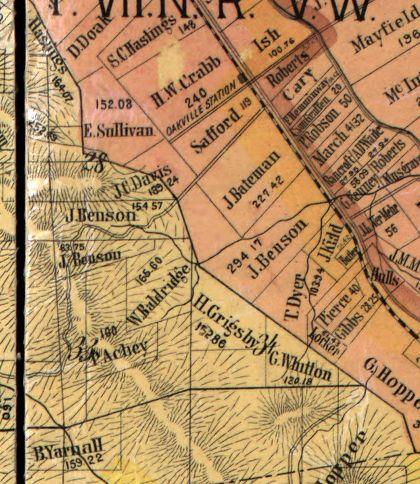
Baldridge was a Master Mason and a charter member of St. Helena Lodge No.93 when it was founded in 1855. He served as a member of the Napa County Board of Supervisors in 1854-56. He never married. Baldridge died in 1902 and is buried in the Masonic plot at St. Helena Cemetery.
Sources
- 1876 Map of Napa County, Library of Congress viewed at their website
- Weber, Lin Old Napa Valley: The History to 1900, Wine Ventures Publishing 1998
- Palmer, Lyman L History of Napa & Lake Counties Slocum & Bowen Publishers 1881
- St. Helena Cemetery Records viewed at
http://www.sainthelenacemetery.com/registry/CemReg1-1-2015.pdf
- Whiteley, Cherri, Celebrating 150 Years of Masonry in the Napa Valley, Napa Valley Lodge
No.93, 2005