
St. Helena Star, December 27, 1878. Transcribed by Mariam Hansen for the St. Helena Historical Society.
The manufacture of wine in some form in this valley, as in the entire state, antedates the discovery of gold (on January 24, 1848), but at that early period had not risen to the dignity of a business. In those days, wine was made in the crudest manner in mere driblets and, according to the old Spanish custom, was manufactured and stored in cowhides. Such things as casks and tanks were then unknown in wine making on this coast, or at least they were not available.
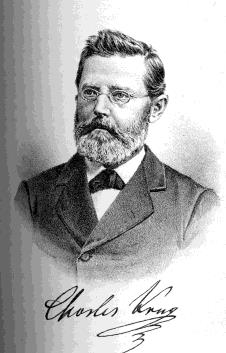
Charles Krug
About 1856 or 1857 Mr. Charles Krug was a young man residing in San Francisco. At the solicitation of a friend who had a small vineyard in Sonoma Valley, he went up to that place and manufactured a small quantity of wine simply as a business experiment, but with not very marked results.
They found that the Valley was well-suited to the production of wine
In the year 1858 he came to this valley and began the manufacture of wine as a business, and on shares at the place of John Patchett of Napa, who also had a small vineyard. There were many vineyards in the state, but all were planted to the Mission grape (or Criolla).
The following year he manufactured a small quantity on the same terms for Louis Bruck (or Bruch) on the old flour mill ranch (Bale Mill) between St. Helena and Calistoga. In 1860 he made wine on shares for old Mr. (George) Yount of Yountville. He thus found by experience that the entire valley was well adapted to the culture of the grape and the manufacture of wine. With this knowledge, he located himself where he now lives (on land obtained when he married Carolina Bale on Dec 26, 1860) and has continued to extend his business up to the present time.
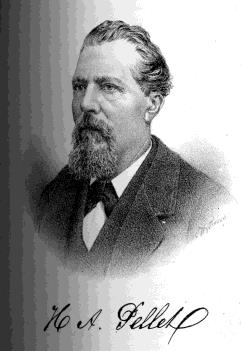
Henri A. Pellet
In the meantime Mr. Krug was followed by Henri A. Pellet at Patchett’s vineyard, manufacturing wine until about the year 1863. He came to St. Helena and made wine for Dr. Crane from a small vineyard of Mission grapes. In 1866 Pellet entered into a partnership with Dimsdell B. Carver, under the name of Pellet & Carver. They continued until this year, when the firm dissolved, both men continuing in the business.
Messrs Krug and Pellet are there for the pioneers in the business in this valley and in this day of their success it sounds somewhat romantic to hear them tell of their struggles and trials in developing what is now the principal business of the Valley and especially of the upper portion: A business which has justly attracted the attention of the entire commercial world to this favored locality.
They saw that a profitable business would result from their humble efforts, but little could they have dreamed of the magnitude of the industry they were so assiduously striving to develop.
Quickly upon their heels followed several other gentlemen in further development of the wine business, but though great quantities could be produced, the wine proved to be of inferior quality (using Mission grapes).
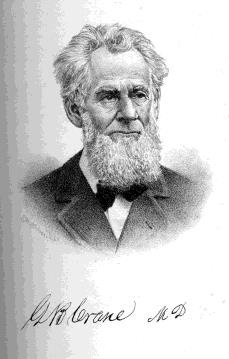
Dr. George Crane
Dr. Crane set out the first vineyard in St. Helena district for the express purpose of winemaking in 1860. This was the first vineyard of foreign grapes (European varieties) in the Valley, which came into full bearing around 1867.
They all made the mistake of planting the Mission grape
In 1861 occurred the great excitement in the wine business in this vicinity, and everybody rushed pell-mell into the business, planting a great extent of vineyard. Among the earliest planters with a view to the business of wine making were Messrs. David Hudson, Henri Pellet, Dr. Eugene Rule, Dr. George Crane and others. Planting the Mission grape was a mistake that has only been rectified after years of labor and vast expenditure of capital. It imperiled the entire business and losses were incurred through the bad reputation of the wines made.
The rush in this district extended to the lower portions of the valley and they soon began to plant vineyards on an extensive scale at Napa and Yountville, but continued the mistake aforementioned.
Foreign grape varieties were planted
Instigated by the success of Dr. Crane’s vineyard of foreign grapes, by the failure to produce readily marketable wine from Mission grapes and by the personal efforts of Mr. Pellet in this direction, wholesale planting of foreign varieties began in this district in 1867-8 (about the time Crane’s vineyard came into full bearing). The Mission grape was as hastily deserted as it had been eagerly adopted.
Most of the foreign cuttings were obtained from Green Valley (then a noted wine producing point in Solano County) and from Sonoma Valley.
The prominent wine growers of this district promoted a business with unlimited success, of which they now felt thoroughly assured and in which their entire energies were now enlisted. The growers decided among themselves to pursue a liberal policy toward those who desired to set up in the business and needed aid by furnishing them cuttings (without charge) of the foreign grapes, then not so readily obtained as now. This course they have never had cause to regret, and of which never fails of ample reward in business.
The great depression and the wine industry
With 1870-1 came a period in the history of wine growing in this district that will long be remembered by those directly interested. It was the period of the great depression in the California wine business, especially of the wine business of this valley and district.
The Mission grapes planted in 1860-1 had now come into abundant bearing and when it was thought that the most sanguine hopes would be fully realized, the wines proved almost worthless or at least of very inferior quality. Several circumstances conspired to produce this unfavorable result, the first of which was the inferior quality of the grape. Inexperience in the business, imperfection of tools and want of proper facilities were other deteriorating circumstances.
Great quantities of these inferior wines had been shipped to eastern states and proving comparatively unsalable, the relapse was immediate and well-nigh fatal. Aside from this, the business was compelled to battle against the prejudices of European wine drinkers in California itself, as well as in the east. Indeed we could scarcely call it prejudice then, it would be now in the full sense of the word, did such a feeling exist at all.
The California wine industry needed to restore its character, reputation and place in the marketplace
Now began the real struggle of the business: for character, a favorable reputation, and a place in the commercial world. Even in the face of these overwhelming difficulties and most disastrous reverses, the three or four pioneers of the district never flinched from the struggle, though they knew it must be long and fought inch by inch. They saw where the difficulty was. They knew well the resources of soil and climate.
They were willing to trust to time and their own dauntless energies to right what had gone so far astray. They now lacked the necessary capital, and what was more, they lacked credit. San Francisco capitalists had ever regarded them with suspicion and now were shyer than ever. It seemed almost impossible to raise funds for the improvements that were now known to be necessary to the success of the business.
The turnaround in commercial markets began in 1876
Little by little these many difficulties were at last surmounted, until finally about 1876-7 the wines of St. Helena district began to attract the attention of the business and found much more ready sale. They were still of a somewhat suspicious character and therefore submitted to the severest and most scrutinizing tests. They came through the ordeal, fulfilling all that had been hoped for them by our anxious wine growers and today St. Helena district stands head and shoulders above any other wine-producing district on the continent for the quality (if not the quantity) of its wines and its products are peer in the market to the best European wines.
Experience taught these early winemakers about the grape varietals that produced better wines
Napa County, along with Sonoma, has gained the general reputation of a high position among wine-producing counties, for these counties have also made general progress in the business, though perhaps not to the extent St. Helena district has done. These results have been brought about by the better knowledge of the business which experience has given, for it was found that the processes of other countries were ineffectual in our peculiar locality. Experience had to produce processes more suitable by better varieties of grapes, which are now European, by improved and larger cellars, and by the abundance of capital which now seeks investment in the business (a certain evidence of prosperity).
In this district orders from eastern wholesale houses now come (in most cases) directly to the producer, an indication of the confidence of eastern dealers in the industry here.
Wine from the Mission grapes was used to make brandy
Of the nearly one million gallons made in St. Helena district this season, scarcely 75,000 are from Mission grapes, which were all used for making brandy. Owing to the fact that the Mission grape has not been more than half a crop throughout the entire state, the aggregate wine manufacture of the past season will fall much below what it would have been with a full crop of Mission.
We carefully inquired and visited many of the cellars of the valley during the past two months. This is what we believe to be a quite accurate statement of the wine manufacture of Napa Valley during the season just closed, though it is possible there may be some unintentional omissions of small quantities.
This plan of wine statistics was originally intended to extend to other wine-producing counties of the state, but we failed to elicit any response from parties in those counties on whom we were compelled to depend for investigation. The figures for our own valley, which we separate into three districts, are named in the order of the quantity of wine production, each individual manufacturing the number of gallons as below tabulated.
| Producer | Gallons in 1878 | Notes |
|---|---|---|
| Charles Krug | 225,000 | today Charles Krug Winery/Peter Mondavi Family |
| William Scheffler | 140,000 | |
| Beringer Brothers | 100,000 | today Beringer Winery/Foster’s Wine Estates |
| John Thomann | 90,000 | today Sutter Home Winery; Trinchero Family |
| T.A. Giaque | 60,000 | |
| John Weinberger | 55,000 | today William Cole Winery/Ballentine Family, across from |
| John Lewelling | 45,000 | Spring & Stockton |
| Jean Laurent | 45,000 | today Markham Winery |
| F. & A. Sciaroni | 42,000 | |
| Fred Metzner & Co | 42,000 | Franco-Swiss Winery, Conn Valley |
| Bernard Tosetti | 25,000 | on Spring St. west of Hudson |
| Richard Heath | 20,000 | today Edge Hill-Leslie Rudd |
| James McCord | 20,000 | on Zinfandel & Hwy 29 |
| Anton Rossi & Co | 9,000 | |
| Conrad Wegele | 7,500 | |
| W.W. Lyman | 6,000 | still is El Molino Winery-Oliver Family |
| Trumpler & Leuthold | 5,000 | |
| Louis Roulet & Co | 1,100 | today Molinari Ranch, Mills Lane |
| Total | 937,600 |