
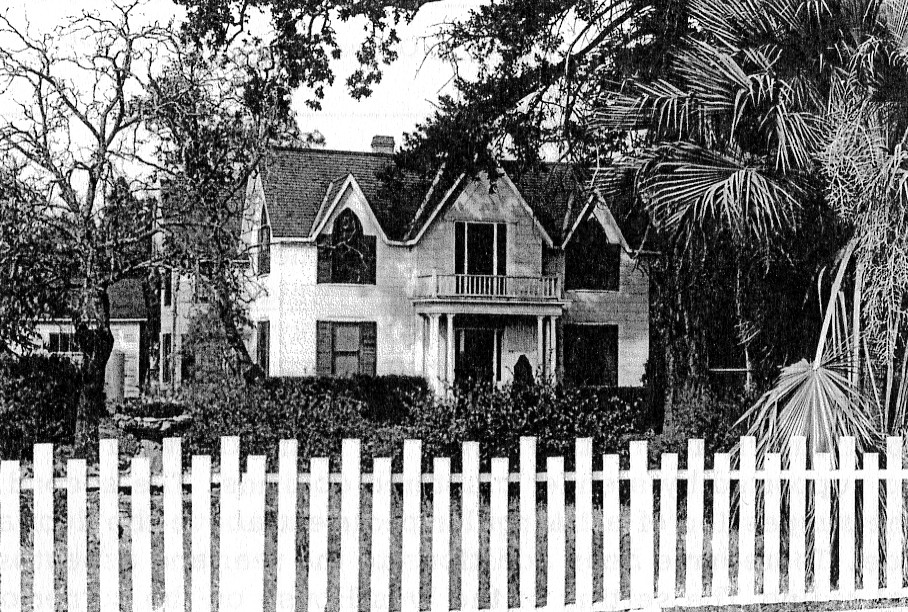
By Mariam Hansen, February 2010. 738 Main Street, St. Helena.
Beginnings
The land on which 738 Main Street was built was part of the Mexican Land Grant given to Dr. Edward Turner Bale in 1841, known as “Rancho Carne Humana”. All of the property records north of Yount Mill Road near Yountville were originally part of this land grant. Dr. Bale died in 1849 and his widow, Maria Soberanes de Bale (later Peabody), began selling off parcels to support her family. In 1861 she had 365 acres south of St. Helena divided into lots, which were sold at auction in San Francisco. Herman Michels and then Hiram and Sarah Ament owned tracts 1 and 8.
The First Chapter
James Ignatius Logan was the son of David and Margaret Phillips Logan, was born in Beaucoup, Washington County, Illinois, on November 6,1829. He remained in that county until he was twenty- nine years of age, and as schoolhouses were somewhat of a scarcity in those early pioneer days, Mr. Logan’s education was home-taught and self-made. He worked on a farm, and afterward learned the carpenter’s trade. In 1858 he moved to Centralia, Marion County, same State, and engaged successfully in the furniture and undertaking business. Although Logan never enlisted, he helped organize a company of men from Centralia, and vowed to see to it that every member returned home . . . alive or in a coffin. Only thirty-two of the company of about one hundred men survived the war. Logan kept his promise, and in so doing, honed his undertaking skills on the battlefields. He received a general pass from Ulysses S. Grant to come and go at will. He (a civilian) was allowed to spend over a month on the battlefields, gathering the bodies of the “boys in blue” he had sent to war. It is said that he shipped over thirteen railroad carloads of embalmed remains, along with personal effects, back home. It was a pioneering — although morbid — achievement in the recovery and proper burial of the fallen from the battlefields. Before the Civil War, such care for the remains of the war dead was rarely seen. Having experience of thirty-five years in handling the bodies of the dead, he was among the foremost in preparing and shipping bodies successfully to all parts of the world, by a method entirely his own, having, under a test, kept perfectly ten bodies more than six months in the vaults of San Francisco. His discoveries in the field were the basis for the modern system of embalming. Also noteworthy, is that James was a first cousin to the father of Gen. John Alexander Logan, who was a distinguished Civil War leader, and among other things, was Commander-in-Chief of the Grand Army of the Republic from 1868 to 1871. . In March, 1864, on account of failing health, he sold out and started with his family overland to California, with mule teams, and arrived at Santa Clara September 29th of that year. Staying there but a short time, he moved to Oakland, where he built a residence and engaged in the real estate business in San Francisco. On July 24, 1865 Logan came to St. Helena.
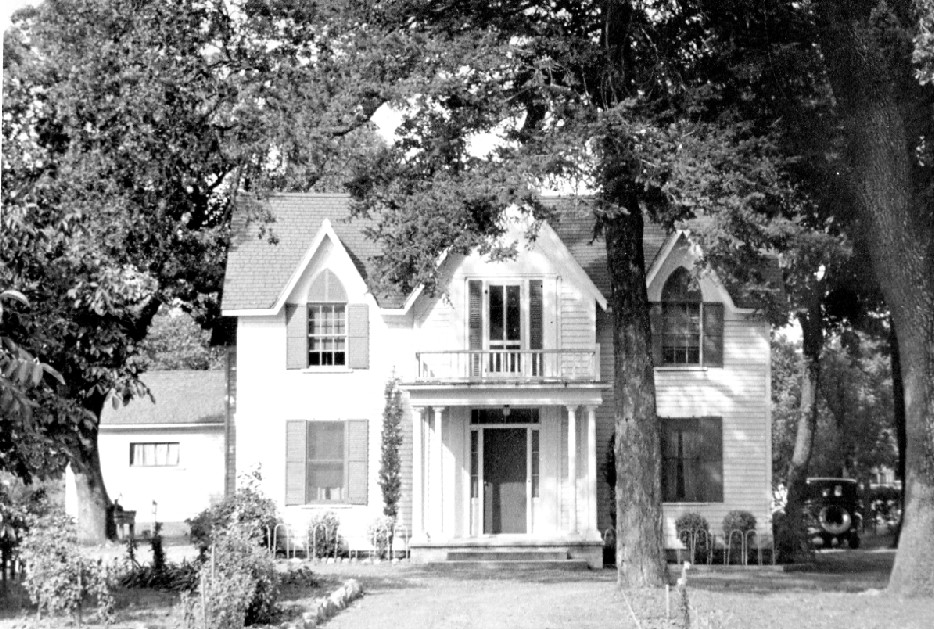
He purchased two 25 acre parcels (Tracts 1&8 on map) from Hiram and Sarah Ament on September 14, 1865 and engaged in farming.
The home we see today is estimated to have been built by him in 1875, now 738 Main Street. He divided his land and laid out Logan’s Addition and Charter Oak Avenue to the town map in 1875. The newspaper reported he laid out the avenue to be sixty feet wide, from his house to the river. Sixteen cottages were built. When the town incorporated in 1876, Logan was in the first group of trustees (now city councilmen). In 1877 he relocated to San Francisco to form the undertaking company of Rodgers & Logan. Rodgers had developed a new method of preparing bodies which kept them in a better state of preservation. Being successful enough in his San Francisco business, Logan returned to St. Helena on April 10, 1878. He engaged in furniture and undertaking, on the west side of Main street, opposite the Oddfellows Hall, and had one of the leading furniture and undertaking houses of the county. Frequent advertisements appeared in the newspaper. Later the business became Logan & Son, then Logan & Simmons. In 1881 the house nearly burned down. It was saved by the prompt response by C.F. Rice and Unity Logan, assisted by the residents of Chinatown (now Taylor’s Refresher). Embers from the chimney caught the roof on fire on a hot, windy day in September. The Logans had no insurance. In December of the same year a fire broke out in the loft of their stable. The building could not be saved, but no animals were hurt. The cause was thought to be a tramp sleeping in the hay.
In about 1891, James Logan sold the undertaking business to John Stewart Noble. He moved to Berkeley and later to Oakland, living on 54th Street in 1910. James Logan died October 5, 1915.
He was united in marriage in Washington County, Illinois, November 15, 1849, to Miss Unity J. Livising, a native of that county and State, and by this union they had seven living children and three deceased: James Melvin, born June 22,1851; cattle exporter to Europe; burial 3-21-1915 St. Helena Cemetery. Alvin Rose, born May 22, 1853, died January 1,1855; Milburn Hill, born August 5,1855 in Richview, Ill; attended UC, became a doctor, died 1905 Celestie Amelia, born September 2,1857, died August 22,1858; Minnie Adelle, born July 6, 1860; married Dimsdill B. Carver, buried 3-6-1943 SHcem, talented artist Charles Mead, born June 30,1863; printer, former owner of St. Helena’s Daily News, joined his father’s furniture/undertaking business. Inez May, born May 19,1866, died February 22,1871; SH Cemetery Aura Pearl, born December 13,1868; SH Cemetery Daisy Dell, born March 31,1873, married Keeney, burial 6-6-1909 SH Cem Roscoe Lee, born September 22,1876, became a doctor, burial 3-9-1926, SH Cem
The Second Chapter
Augustus Andrew Ives was the son of Richard and Mary Ives who was born in Kansas City on May 10, 1858. When he was four years old he crossed the plains with his family and settled in Suisun Valley in 1862. Richard engaged in farming and his son Augustus followed him in this profession. Later, Augustus moved to Napa and engaged in the livery stable business for two years. The 1880 census shows him working on a ranch at Knoxville, near the mines and living with his mother (now Mary Duvall). After a short stay in Texas, Augustus returned and married Cassie Lane on December 29, 1887. Cassie Lane was born south of St. Helena, the daughter of Robert and Elizabeth Lane (died Oct 11, 1909), pioneer residents. She graduated from State Normal School at San Jose (San Jose State University today) and taught in local schools for many years.
Augustus and Cassie bought 738 Main from J.W. and Rosamond Robinson of Long Beach, CA on March 24, 1906. Augustus purchased the express and drayage business of Charles Jackson. Trunk and piano moving was his specialty. He was an agent for Cook’s Mineral Water. In 1919, at the age of 61, he sold the business to T. J. Critchley & Son. Thereafter he purchased land north of St. Helena and tended his orchard and vineyard. He was elected to the city council in 1930 and also served as a St. Helena Cemetery Association trustee. He was a staunch and true Democrat, frequently serving as delegate to county and state conventions. In 1934 Augustus died. His wife continued to live in their home at 738 Main Street (at Charter Oak) until March 10, 1938, when she died in Oakland at the home of her daughter. Sibyl Ives Carter was a school teacher in Oakland.
The Third Chapter
Sibyl and Jess Carter sold the property on July 3, 1940 to William and Emma Ramsey.
The Ramseys came to St. Helena in 1939 from Saratoga, acquiring several properties. They lived at the Logan-Ives home until 1942, when it was sold.
The Fourth Chapter
Everett Albert Bellani was born in Sacramento on Dec 7, 1908 to Albert Joseph and Louise Fitzgerald Bellani. He attended Sacramento schools and played clarinet in the band for 10 years. Summers were spent in St. Helena with his uncle and aunt, Edward and Frances Bellani. Everett played in St. Helena bands and on local baseball teams. Edward owned a trucking business here. After trying to dry farm in Sacramento valley, Everett bought his first truck in 1931 to haul grapes and wine. He came to St. Helena to help his uncle Edward in the wine hauling business, buying it in 1937. Everett married Margaret Goethe of Sacramento in Reno, moving with her to St. Helena.
On March 19, 1942 they purchased the Logan-Ives home at 738 Main Street from the Ramseys.
Everett and Margaret had two daughters: Donna and Evelyn. In his spare time, Everett managed the Curtis Ranch at the end of Whitehall Lane, which had been owned by Edward Bellani. Jean Van der Kamp became his second wife in 1960. They continued to operate the wine hauling business together. In 1974, Bellani Trucking was sold to his daughter and son-in-law. To keep busy, Everett took a job at the St. Helena Chevron gas station. He was a member of Sons of Italy, Calistoga Native Sons, Lions Club and Silverado Riders. He served for many years on the Napa County Fair board of directors. Everett Bellani died on March 20, 1992. His wife Jean died in 1995. Daughters Donna Bellani Lauritsen and Evelyn Bellani Pridmore of Napa and stepson Martin Van der Kamp survived them.
Kevin Twohey purchased the Whiting’s Nursery business from David and Margaret Whiting in 1986. In 2003 he leased 738 Main Street from Martin Van der Kamp. In November 2004, Kevin moved his nursery business. The old house was worn, but it was used for offices and as a caretaker’s quarters. A new barn and a smaller were constructed for the nursery. Napa Register 10-6-09:
The tasting room will be housed in the 1872 farmhouse, also known as the Logan-Ives House, used as a storehouse by Whiting’s. “It was uninhabitable,” Hall said of the structure. “We’re renovating it and retaining its historic character as a gothic farmhouse.” The ranch’s administrative offices will occupy the second floor.
In one of its first steps in renovation, Long Meadow raised the house and replaced its foundation; the house had been sitting on rock and some redwood stumps.
“We’ve salvaged 95 percent of the materials from the farmhouse,” Hall noted. “We’re using them in the finishing process, including redwood at the bar with foot rests made of old galvanized pipe.” All of the original siding and windows will be used, even old icebox doors. Period decorations will reign throughout, including wainscoting, light fixtures and wooden floors. A fireplace will be flanked by high-backed settees.
Sources History of Northern California, page 341-2 St. Helena Star Archives Dean Enderlin Napa Valley Register US Census St. Helena Star July 5, 1940